
[ Home TNT-Audio | Staff & Contacts | HiFi Playground | Listening tests | DIY & Tweakings | Music & Books ]
Our measurement series on some of the speakers we have reviewed could only begin with the Lonpoo LP42, as it is a speaker that raised a huge dust storm.
The question we asked ourselves is: how will these little guys perform on our measurement test bench?
I remind all readers that we have published here our measurement protocol. Obviously, we have to deal with the limitations of the equipment in our possession, but we can still guarantee a good margin of precision; all the details are in the presentation article of the speaker measurement protocol!
Below you will find the impedance comparison between the two speakers. In an ideal condition, the two curves should be perfectly overlayable. A slight deviation between the traces is nevertheless completely natural and is due to the standard matching tolerances of the drivers and passive crossover components.
The chart clearly shows that the impedance curves of the two speakers follow a similar trend, while highlighting marked discrepancies in their resonance peaks and a constant difference of nearly 1 Ohm in the 2 to 4 kHz range (with a general tolerance within 0.5 Ohms across the rest of the spectrum). This tangible gap confirms that the transducers and crossover components were not well matched, underscoring the inevitable manufacturing tolerances typical of budget components.
This comparison allows us to evaluate the consistency between the speakers provided by the manufacturer, a very important aspect for correct stereophonic reproduction that is rarely documented in reviews. Significant differences between the two speakers can indeed affect the tonal balance and the stability of the soundstage. The frequency responses of the two units are measured on-axis (0 degrees), a 1/12 octave smoothing was applied, and the gating window was reduced to 3 ms to observe the phenomenon more clearly.

The comparative analysis of the on-axis frequency response between the two speakers available for measurement highlights a wide divergence starting from 5.5 kHz, only regaining consistency above 10 kHz. The response shows a highly irregular trend, characterized by sharp peaks and deep amplitude cancellations. We will come back to this shortly when we look at the 0, 30 and 60 measurements.
A fundamental analytical element concerns the different locations of the notch points between the two speakers: on one channel, the main cancellation occurs around 7 kHz, while on the other, it shifts towards 8 kHz. This shift demonstrates how the loose tolerance of poor quality capacitors directly interacts with the acoustic interference phenomenon: a capacitor does not directly create narrow dips or peaks in the response. However, a high tolerance (for example, a 20% variation in actual capacitance between the two channels), combined with poor electrical driver matching, changes the crossover frequency and the electrical phase shift introduced on the tweeter signal. Since the notch occurs only at the exact point where woofer and tweeter emit in perfect phase opposition, the capacitance deviation shifts the frequency where 180-degree cancellation is reached forward or backward in the audio spectrum. In summary, the relatively wide tolerance of the capacitors could, in this case, act as the trigger for the variation, by altering the tweeter's phase relationship and causing its interference with the unfiltered woofer to produce cancellations at different frequencies in the two loudspeakers of the same pair.
Acoustic measurements highlight a decidedly poor pair matching in the high frequency range (from 5.5 kHz to over 10 kHz). In the region between 5.5 and 10 kHz, the measured speakers do not behave like a true matched pair, but rather like two distinct units.
To optimize this design, using tight-tolerance capacitors represents an essential intervention to upgrade the response between the left and right channels. This intervention has already been performed and is recommended in our recent article.

The analysis of the frequency response at zero (red line), 30 (yellow line), and 60 (blue line) degrees immediately highlights a tonal imbalance distinctly oriented towards the high frequencies, as already observed in the previous image. Starting from 1 kHz, the response rises decisively, reaching significant output peaks. This excess gives the speaker a hyper-detailed, bright, and potentially fatiguing timbral character. Beyond the general imbalance, the high range exhibits a heavily jagged response caused by the choice of a minimalist crossover. Being unfiltered, the woofer extends as far as its mechanical limits allow, entering full breakup mode.
This adds to the problem that the two drivers together reproduce a wide range of frequencies, reaching the listener with a time-domain misalignment, compounded by the electrical phase rotation introduced by the capacitor on the tweeter. Depending on the frequency, this offset can cause the two waves to meet in phase (adding together and reinforcing the sound) or out of phase (cancelling each other out, producing an actual dip in the response).
The result is a series of peaks and dips alternating across the entire frequency range involved. On-axis, where the two drivers contribute at similar levels, the contrast between peaks and dips is most pronounced. Moving off-axis horizontally, the woofer's beaming progressively reduces its output at higher frequencies: its contribution diminishes, and the cancellation at 30 and 60 degrees around 7 kHz tends to become less pronounced, resulting in a smoother, more even response than on-axis.
Ultra-high frequency resonances (8, 9 and 11 kHz): saw-tooth peaks in the brilliance region reveal others resonances.
We can add a few technical considerations regarding in-room placement thanks to measurements no longer taken under pseudo-anechoic conditions, but in an actual room where I tried to make these small speakers sound their best. This measurement aims to demonstrate how room positioning plays a fundamental role.
In this specific case, a totally anti-audiophile placement allowed the limitations highlighted by pseudo-anechoic measurements to find effective compensation when moving to in-room response measurements. In a classic, textbook audiophile setup (speakers placed far from walls with moderate toe-in), the system would suffer from an impoverished low end, combined with excessive high-frequency harshness and sharp interference dips. In-room measurements show that the speaker responds well to an unconventional setup. Below is the image of the in-room measurement (1/6th octave smoothing).
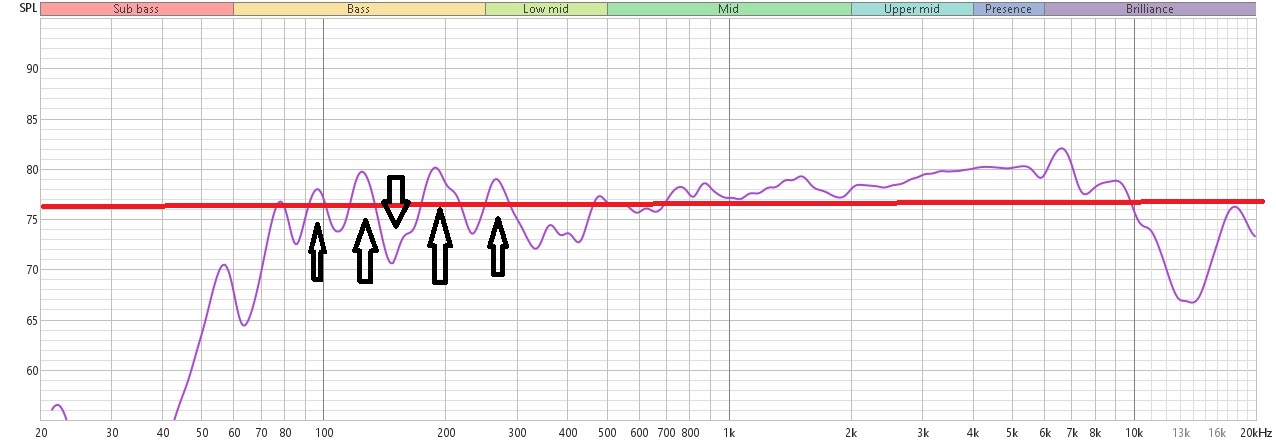
Placing the speaker right against the back wall takes advantage of boundary loading, boosting the level of low frequencies below the room's transition zone. This low-end reinforcement energetically balances the tweeter's excess, restoring a more coherent overall tonal balance. The price to pay is an exacerbation of room modes, uneven bass reinforcement, and cancellations that result in particularly pronounced peaks and dips below 300 Hz. This phenomenon is not due to the speakers themselves, but to their interaction with the room.
Extreme toe-in: applying an unconventional, steep orientation angle allows bypassing the drastic on-axis cancellation at 7 kHz and taming the elevation in the high and ultra-high frequencies.
In conclusion: all the flaws found (the use of a single poor-quality capacitor, high tolerances, unfiltered breakup) are not design blunders, but inevitable economy-of-scale choices to hit such an aggressive retail price. For 36 euros a channel (as of August 2026), expecting a refined second-order crossover, tight-tolerance components, or perfectly matched drivers is simply unrealistic. All the issues identified on the test bench are the inevitable price to pay for bare-bones engineering. By leveraging unconventional placement, one can mitigate the tweeter's excess and improve the low end.
[Go the the Lonpoo LP42MX test bench results]


DISCLAIMER. TNT-Audio is neither a shop, nor a HiFi company or a repair laboratory for HiFi components. We don't sell anything. It is a 100% independent magazine that neither accepts advertising from companies nor requires readers to register or pay for subscriptions. We do not use affiliate links. If you wish, you can support our independent reviews via a PayPal donation. After publication of reviews, the authors do not retain samples other than on long-term loan for further evaluation or comparison with later-received gear. Hence, all contents are written free of any “editorial” or “advertising” influence, and all reviews in this publication, positive or negative, reflect the independent opinions of their respective authors. TNT-Audio will publish all manufacturer responses, subject to the reviewer's right to reply in turn.

© Copyright 2026 Matteo Bruni - matteo@tnt-audio.com - www.tnt-audio.com
[ Home TNT-Audio | Staff & Contacts | HiFi Playground | Listening tests | DIY & Tweakings | Music & Books ]