[ Home TNT-Audio | Staff & Contacts | HiFi Playground | Listening tests | DIY & Tweakings | Music & Books ]
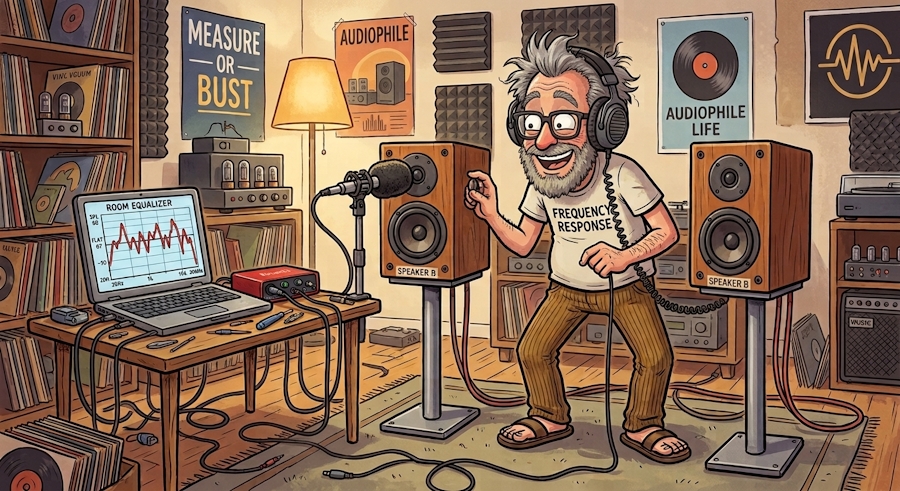
The measurement of loudspeakers is an important tool for understanding their actual behaviour, going beyond listening impressions that can be influenced by the environment, placement, and inevitable subjective factors. A consistent and repeatable measurement protocol makes it possible to analyze fundamental aspects such as frequency response, off-axis dispersion, low-frequency behaviour, electrical impedance, and consistency between the two units of a pair.
The objective of this protocol is to provide a transparent, repeatable, and explicitly limited technical analysis methodology, suitable for evaluating loudspeakers in a non-anechoic environment. Measurements are carried out in a domestic setting using accessible yet reliable tools, with the aim of producing data useful for understanding loudspeaker behaviour without attributing a level of precision that would require dedicated professional facilities.
The protocol arises from the need to complement subjective reviews with a set of objective measurements, carried out according to consistent and well-documented criteria. All procedures have been designed to ensure:
Repeatability of measurements
Clarity regarding accuracy limits
Comparability between different loudspeakers
Methodological transparency
Measurements are performed using FFT analysis with the software Room EQ Wizard or ARTA, together with omnidirectional measurement microphones. Although these tools do not belong to the class of professional instrumentation used in research laboratories, they allow sufficiently accurate results for comparative technical evaluation, provided that the intrinsic limitations of the method are clearly stated and respected.
Since measurements are carried out in a domestic environment, time windowing (gating) is applied to reduce the contribution of room reflections. This approach allows reliable frequency response measurements above approximately 300-400 Hz, while complementary techniques are used for low frequencies, such as ground plane measurements or near-field measurements of individual system components (woofer and bass reflex port). The combination of these techniques makes it possible to reconstruct a plausible full-range response of the loudspeaker, while explicitly acknowledging a small degree of uncertainty in the transition regions between the different measurement methods.
Measurements are taken without applying smoothing greater than 1/24 octave, unless otherwise specified, with the microphone positioned at tweeter height, and after a loudspeaker stabilization period of at least two hours.
The protocol includes:
On-axis measurements
Horizontal off-axis measurements
Electrical impedance measurement of the loudspeaker
A particularly important aspect of the protocol is the verification of matching between the two speakers in a pair. Whenever possible, both the frequency response and the impedance curves of the two units are compared. With this we can assess the consistency between the loudspeakers supplied by the manufacturer, a very important aspect for correct stereo reproduction that is rarely documented in reviews. Significant differences between the two speakers can affect tonal balance and the stability of the stereo image.
The combination of these measurements allows different aspects of loudspeaker behaviour to be described, including:
Frequency response linearity
Angular dispersion
Structural resonances
Consistency between the two units of the pair
A fundamental principle of this protocol concerns the relationship between measurements and subjective review. To avoid any form of cognitive bias, the subjective evaluation of the loudspeaker is carried out before the publication and analysis of the measurements. The reviewer therefore does not have access to the measurement data during the listening phase, in order to prevent technical information from influencing perceptual judgment. Measurements are published and discussed after completing the subjective review thus allowing comparison between listening impressions and objective data.
This approach does not aim to replace subjective reviews or measurements performed in laboratory conditions or in anechoic chambers, but rather to provide a coherent, honest, and repeatable technical framework useful for interpreting loudspeaker behaviour and comparing different products within a consistent methodological context. In other words, the purpose of this protocol is not to eliminate uncertainty - impossible in a domestic environment - but to make it explicit, controlled, and comparable.
It is important to emphasize that such a comparison does not constitute a validation of either the loudspeaker’s quality or the reviewer’s accuracy, but rather represents an opportunity for critical analysis between perception and measured behaviour, within the declared limits of the protocol.
The analysis of the measurements will focus on the most relevant findings, contextualizing them according to the price and market segment of the speaker.


DISCLAIMER. TNT-Audio is neither a shop, nor a HiFi company or a repair laboratory for HiFi components. We don't sell anything. It is a 100% independent magazine that neither accepts advertising from companies nor requires readers to register or pay for subscriptions. We do not use affiliate links. If you wish, you can support our independent reviews via a PayPal donation. After publication of reviews, the authors do not retain samples other than on long-term loan for further evaluation or comparison with later-received gear. Hence, all contents are written free of any “editorial” or “advertising” influence, and all reviews in this publication, positive or negative, reflect the independent opinions of their respective authors. TNT-Audio will publish all manufacturer responses, subject to the reviewer's right to reply in turn.

© Copyright 2026 Matteo Bruni - matteo@tnt-audio.com - www.tnt-audio.com
[ Home TNT-Audio | Staff & Contacts | HiFi Playground | Listening tests | DIY & Tweakings | Music & Books ]