[ Home TNT-Audio | Staff & Editorials | HiFi Playground | Listening tests | DIY & Tweakings | Music & Books ]
Author: Lucio Cadeddu - TNT-Audio Italiy
Published: October, 2026
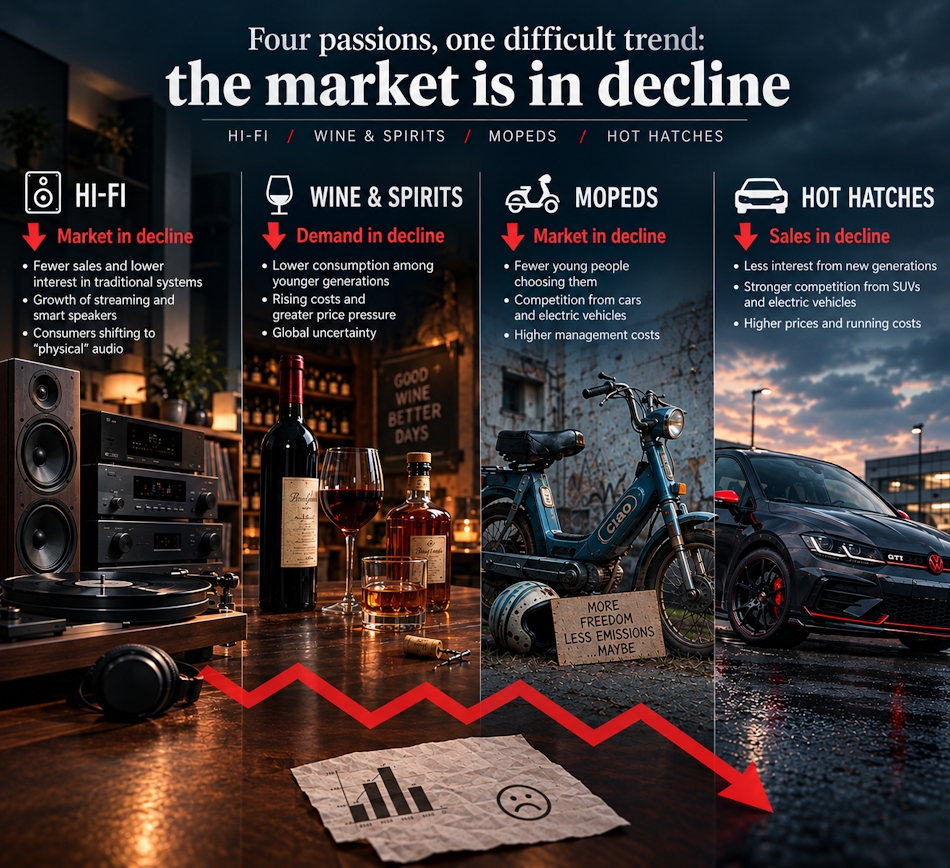
I am looking at three markets that, at first glance, seem unrelated: hi-fi, wine and spirits, and the traditional automotive sector. I've been writing about the crisis in hi-fi for years and, for the purposes of this article, I'll leave that discussion aside. Let me simply recap the two pillars of my argument, which will be useful for comparison: there is no meaningful generational turnover, and prices have spiralled totally out of control.
A look at recent market analyses suggests that these same issues are now affecting other industries as well. The wine and spirits market is going through an especially difficult period: consumption is falling worldwide, younger generations are showing increasingly little interest in “responsible” drinking, and wine prices have drifted completely beyond the bounds of reason. Twenty years ago, global consumption stood at more than 240 million hectolitres; today, it has plunged to 208 million hectolitres, the lowest level recorded since 1957.
That's not just my opinion, but the conclusion reached by respected observers across the globe. For example, let me cite an article by Eric Asimov, wine critic at the New York Times, titled What Can Be Done to Save the Ailing Wine Industry? Our Critic Has Thoughts.
The wine trade is in trouble. With a combination of declining consumption, rotting fruit left on the vine, public health warnings, tariffs and the overarching crisis of climate change, most people would agree that wine faces challenges. [...] The greater wine world, by which I mean producers, distributors, restaurants and retailers, needs to cut the cost of wine. Younger people are not buying wine at the same rate as older generations, and one significant reason is prices are too high, particularly with American wine. [...] Except for those working in high-paying fields, few younger people are willing to spend more than $20 for a glass of wine in a restaurant or $50 to $100 a bottle in a wine shop. [...] Restaurants and retailers must do their part by not jacking up prices. Catering only to wealthy people may build short-term profits but it will kill the industry. Making it more affordable to younger people will help to assure a continued audience. [...] Lose the Snobbery! Wine must be made more inviting. What makes it forbidding and intimidating? Not the delicious beverage itself. No, it's the belief that one must learn about wine before enjoying it. No single practice has killed more American wine bars than their insistence on trying to educate people who merely want wine to have a good time.
Does this ring a bell for the HiFi industry leaders? Search and replace “wine” with “HiFi” in the text above and you'll understand my point.
And what is happening in the automotive world? Leaving aside electric vehicles, which are still struggling to achieve widespread adoption, the market for traditional internal-combustion cars is also losing momentum. The same is true of the tuning scene many of us grew up with, a world that has much in common with DIY audio and is now facing a similar decline. Just look at the collapse in young people's interest in mopeds and so-called hot hatches, those small economy cars with a decidedly sporting edge. Every manufacturer used to have one in its line-up; now they have virtually disappeared, unless we are prepared to call the GR Yaris a hot hatch, which is really a rally car in disguise, available from a modest €52,000 in its entry-level version.
Not unlike the situation with the "conventional" Abarth 500. And forgive me if I refuse to consider the electric Abarth a hot hatch when it comes fitted with a subwoofer whose sole purpose is to imitate the sound of an internal-combustion engine. So sad.
Now, let's see some raw statistics! 20 years ago market share: in regions like Europe and Australia, small/compact cars captured roughly 20% to 25% of the total new car market. The VW Golf, Ford Focus, and Opel Astra routinely filled the top 5 best-selling cars lists. Modern market share: the compact segment has haemorrhaged sales at an accelerated rate. In recent years, small car sales plummeted by 67%, with their total market share collapsing to under 8%. In the United States - a market historically difficult for hatchbacks - the decline is even sharper. The true "hot" hatchback market has shrunk significantly. Data tracking the "warm hatch" segment shows that mainstream options have all but evaporated. Only niche luxury-adjacent players like the Mini Cooper remain at the top of the chart with modest volumes (∼11,000 units), while former budget favourites have either seen double-digit declines or been discontinued entirely.
Twenty years ago, in Europe, the hot hatch segment accounted for well over 100,000 to 120,000 registrations annually. Today, total volumes have collapsed by more than 80-85%, with sales across the entire continent estimated at fewer than 15,000 to 20,000 units a year. Against this backdrop, the market for vehicle and scooter modifications has inevitably followed the same downward trajectory, sustained nowadays largely by ageing enthusiasts and a handful of die-hard nostalgics.
Indeed, the global crisis of the traditional petrol moped market (specifically 50cc internal combustion engine vehicles) is even more severe than the decline of hot hatches. What was once the absolute cornerstone of teenage independence and urban mobility - iconized by the Piaggio Sì, Peugeot 103, and 50cc Vespas - is now in a terminal sales free-fall globally. Recent European manufacturing and registration data shows that while larger motorcycles and maxiscooters remain relatively stable, the moped sector has routinely collapsed by 14% to 30% year-over-year across core markets like France, Germany, Italy, and Spain. Hence there's a profound crisis of the market of petrol engine mods and tweaks.
Particularly illuminating is the account by Andrea Pinasco, the undisputed king of Vespa and scooter tuning, published in a piece for Vespanatics. Here are a few excerpts:
One of the reasons I decided to sell the company was young people's growing disengagement from the world of Vespas and engines in general. Back in the 1970s and 1980s, my stand would literally be besieged by teenagers and twenty-somethings. By the 1990s, young people had discovered the Internet and were spending their days in front of a computer. [...] Even with a vivid imagination, I could never have envisioned a day when performance kits would be sold primarily to retirees. A day when it would no longer be sons and grandsons spending their evenings, and sometimes their nights, in the garage, but grandfathers instead. [...] Today, I find it difficult to understand what people my age are expressing when they modify a scooter. Perhaps it is above all nostalgia: nostalgia for a time when it took very little to be happy, when there was always a friend willing to get their hands dirty alongside you, a time when rebellion and the desire to change things still meant something.
People used to get their hands dirty working on engines; with DIY audio projects, they would burn their fingertips on a soldering iron. How many young people still do either today? Andrea Pinasco writes: “Timidly, without making a fuss, we stay in our corner, assembling and disassembling things with grease-stained hands. And though we try not to show it, our hearts light up whenever a young person becomes curious and stops to watch.”
That is the spirit that has always driven us as well: sharing our passion and taking quiet satisfaction when a young listener asks for advice on how to improve their audio system, perhaps on a very modest budget. Nostalgia alone, however, is not enough. What is needed is a change of direction. Or perhaps a calm acceptance that the world has changed, and far more quickly than any of us could ever have imagined.


DISCLAIMER. TNT-Audio is neither a shop, nor a HiFi company or a repair laboratory for HiFi components. We don't sell anything. It is a 100% independent magazine that neither accepts advertising from companies nor requires readers to register or pay for subscriptions. We do not use affiliate links. If you wish, you can support our independent reviews via a PayPal donation. After publication of reviews, the authors do not retain samples other than on long-term loan for further evaluation or comparison with later-received gear. Hence, all contents are written free of any “editorial” or “advertising” influence, and all reviews in this publication, positive or negative, reflect the independent opinions of their respective authors. TNT-Audio will publish all manufacturer responses, subject to the reviewer's right to reply in turn.

Copyright © 2026 Lucio Cadeddu - editor@tnt-audio.com - www.tnt-audio.com
[ Home TNT-Audio | Staff & Editorials | HiFi Playground | Listening tests | DIY & Tweakings | Music & Books ]