[ Home TNT-Audio | Staff & Contacts | HiFi Playground | Listening tests | DIY & Tweakings | Music & Books ]
Product: Seismic Podiums
Manufacturer: Townshend Audio - UK
Price:See below - depends on platform size, from UKP1798-UKP4109
Reviewer: Mark Wheeler - TNT-Audio UK
Review period: Spring - Summer 2026
Published: October, 2026
This review of the Townshend Seismic Podium loudspeaker support system begins with some basics and some audio history and mythologies. This is to pre-empt and arguments and is therefore unnecessarily comprehensive for some readers who may skip a few sections. Every single part of the audio chain is susceptible to vibrations. Every audio thing is either generating vibrational energy, absorbing vibrational energy, or doing both. Apart from the vibrations in the air that are conveying music to our ears, all the other vibrations are a problem.
Although the audio and electronics press only seem to have been obsessing about this since the late 1970s, the AES journals and old patents indicate that this has long been recognised and various approaches have been proposed over the years. Hard spikes and squishy pads are two of the dominant narratives, both have adherents who are certain of their beliefs.
For over half a century audiophiles (who were known as Hi-Fi enthusiasts at that time) have mostly believed that carpet piercing spikes are the way to support loudspeakers. For the most part the carpet piercing spikes are also piercing wooden floors below the carpet. It is OK for four spikes to be doing this but when four spikes are on tiled or other masonry floors, one of the four spikes will always chatter. On hard surfaces three spikes will always, without any exception, ever, anywhere on this planet, be better and more effective than four spikes at doing whatever it is that spikes do.
There are numerous absolutely certain theoretical positions regarding exactly what it is that spikes do. Certainty always rings alarm bells in any quasi-scientific explanations of anything.
Why are spikes supposedly essential for propping up loudspeakers? Sadly many of these theories contradict one-another, some arguing that spikes decouple loudspeakers vs an alternative argument that they couple via the high pressure at the tip. Yet there are other arguments that the spike acts like an energy draining diode, which seem based solely on the resemblance between the silhouette of a spike and the diode electrical symbol. I have had success with various types of spikey thing in assorted loudspeaker contexts and one size does not fit all. Certainly your Old Scribe has conducted many, many, many experiments comparing various combinations of spikes, compliant decoupling, screws into the wooden floor, and mixtures of all of the above. Your Old Scribe has also compared; bare concrete; ceramic tiled concrete; slate tiled concrete; suspended wooden floor; reinforced wooden floor; wooden floor locally coupled to masonry by steel or hardwoods.
These experiments have been during ownership of 5 successive houses with diverse construction, installation of playback and sounds systems, and helping fellow sufferers of audiophilia nervosa to optimise their systems. The lessons are not as straightforward as many writers and sales people would have us believe. As usual, context is everything.
What works somewhere does not work everywhere. That caveat also applies to this review.
Loudspeakers of any value will be converting a lot of electrical energy into a lot of acoustic energy. The more capable they are of doing this, the more challenging they become. Wider bandwidth affects a wider range of frequencies and lower frequencies present much bigger problems due to their greater wavelengths and consequent greater air movement. Wider dynamic range presents a wider range of problems, because the big air movements, and the mechanisms to create them, are much more likely to move more than just our eardrums.
Therefore wide bandwidth, wide dynamic range, loudspeakers present bigger, wider, deeper, challenges. Cleverly limiting either bandwidth and/or dynamic range therefore has many seductive charms (think Lowther or LS3/5a) but the Euterpe project, Mark's muse of music, wants more of everything. I want the charms of a high sensitivity midrange driver driven by a Single Ended Triode along with the bass-ic air movements of a pukka sound system.
Sir Isaac Newton stated ideas about mass and motion that became identified with him as Newtonian mechanics. The three rules might be paraphrased as follows:
We are all taught these rules at secondary or high school and the third rule is the one most mooted by audio sages in the late 1970s. The theory is that the bass cone, typically weighing anything between 6 and 30 grammes (6 x 10⁻³kg moves rapidly forward or backward by its xmax. This is typically between 6 and 11mm (6 x 10⁻³m to 11 x 10-3m). It's mass x velocity must be equalled by the opposite mass x velocity in another part of the system. The whole loudspeaker baffle theoretically moves in fact.
The argument goes that the resultant movement is in the order of magnitude of the high frequency driver signal and therefore will distort that signal. Thus, coupling the loudspeaker to the mass of the floor reduces this movement. A compact loudspeaker system mass might be only 2kg and its bass-mid cone mass 20g (2.0 x 10⁻³, so in a frictionless environment the whole loudspeaker system might move 4 microns. At 10kHz the tweeter is also moving only microns so the argument goes that these are similar orders of magnitude and therefore will cause intermodulation distortion to the tweeter output when the whole loudspeaker moves in reaction to the bass cone movement. Even assuming the estimated masses and movements would be correct in frictionless outer space, so many other factors actually affect whether this is a real phenomenon or not. Some loudspeakers like those in the 1980s from Naim and Roksan had expensive mechanisms to avoid these interactions and they did sound remarkably clear but this does not prove the hypothesis as other vibrational effects might have been involved.
So after years of interpreting Isaac Newton's laws of motion to mean that loudspeakers must be kept as rigidly locked into space as possible to preserve musical detail, your Old Scribe decided to test the hypothesis. The theory that a few grams of loudspeaker voice coil plus cone being launched forward by the motor system, will produce an equal and opposite reaction backward by the whole system does not seem to get measured in the same way that isolation gets measured.
In the early the days before spikes with everything trended, they weren't available to buy. So your Old Scribe turned bolts down to make spikes on hearing rumours that they would better couple loudspeakers to planet earth. Yes, spikes do a sterling job of coupling due to the very high pressure concentrated at their tip. Spikes do not work by decoupling. Spikes cannot decouple, nor can they act like a diode, draining energy away from the loudspeaker cabinet into the ground. Spikes couple both ways which is why your Old Scribe has long advocated buying houses with masonry floors for such reasons. Coupling our sound system to the whole of planet earth has seemed like as sensible an idea as any of the alternatives. A big thermal mass of concrete (preferably containing underfloor heating pipes to avoid resonant radiators) has always seemed a desirable non-resonant option.
However, your Old Scribe now owns a house built in 1860 with exceptionally solid thick stone walls but wooden floors on joists and I have no desire to dig out the floor and cast a concrete mass. These solid masonry walls support an effective sand filled turntable shelf, which is a good enough compromise between the differing needs of subchassis and solid plinth turntables. What to do about the 68kg bass section of the Euterpe loudspeaker system?
A selection of aluminium, brass, steel and exotic hardwood cones, spikes and spike sockets have been tried. A selection of vibration absorbing sheets, pods, and blocks of solidified rtv silicone were also tried. Every arrangement sounded different. One surprisingly promising, and relatively cheap, option was a section of the type of compliant closed cell matting sold for insulation under sleeping bags when camping. Multiple layers had as many disadvantages as advantages. Combinations of a cone at the rear centre and sleeping mats across the rest had much more promise. The hypothesis I developed is that some kind of more sophisticated arrangement is needed that offers vertical compliance while resisting fore-aft rocking. After reading many manufacturers' blurb and noticing what seemed to work in audio show hotel rooms, I decided to try some.


This is a Real Stereo page, so you will need more than one Seismic Podium, you will need 2 Seismic Podia. Or should that be Podiums given that this is a proper name on our English and Italian pages, read only by modern Romans, not ancient Romans?
Your Old Scribe met Max Townshend a couple of times at hi-fi shows and he was always a friendly outgoing Aussie stereotype. This is handy given that he was in the stereo business and was born in Perth, Australia. Max Townshend died on December 31, 2021, aged 78. Max was an entrepreneur who embraced innovative or groundbreaking approaches to domestic audio, unafraid to engage other experts and innovators to contribute to designs, like the famous headshell end pickup arm damping trough originally conceived by Jack Dinsdale. Once the spikes with everything narrative had become the dominant hegemony, along comes Max Townshend to argue the opposite.
Phase anomalies, such as those caused by early reflections or loudspeaker micro movements, could be the main culprits in soundstage inaccuracy. I refuse to use the even dafter and wildly misleading term stereo image - only a Stereoscope can create a stereo image and Brian May is even more likely to be behind your stereoscope than the output of your stereo system. Therefore if rigidity is essential for this performance parameter, we might anticipate anything less than big chunky spikes will be detrimental to soundstage. However, Townshend claim that “Seismic Isolation will improve the sound-stage resulting in a more clearly defined image placement and instrument position, a greater degree of silence during the quieter segments of music and an improvement in the dynamic range.”
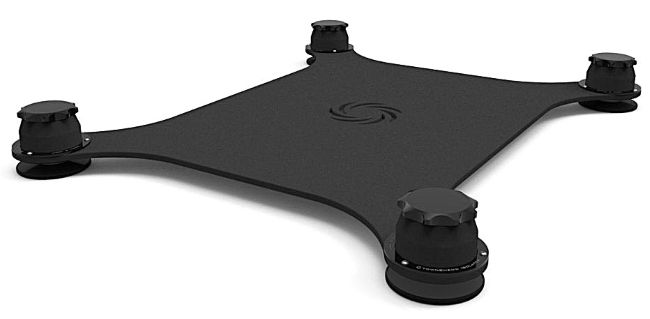
These are expensive pieces of kit and the build quality matches that expense. The podiums are hand built in the UK and it shows. I'm sure they could ship them cheaper from a poverty wage economy somewhere but that would be inappropriate in a high-end hobby. The podiums are built to last, so you'd better be keeping the same mass of loudspeaker for years to come! They are made of proper metal, as my BSA owning partner says, and finished in a good industrial style with no pretence at being something they are not. The thick steel main plate is creatively drilled, shaped and coated with a thick wrinkle black finish and it does not ring. More Bauhaus than Hepplewhite.
The Townshend Seismic Podium(s) isolate the supported component from 3Hz upwards. This means that the suspension pods on each corner of the Seismic Podium has to be correct for your own loudspeakers, mine being 68kg for the bass section alone, which you can see by the coloured load spot on the corner pod. The loudspeaker theoretically bounces like a suspended subchassis turntable. This involves adjusting the 4 corner load cells to ensure free vertical movement of platform and loudspeaker. Thus we have just added two more set-up paranoia sources to the poor old audiophile's anxiety quotient. If we subsequently realise that we need to make a slight adjustment to loudspeaker position, the whole procedure starts again.
Before trying the podiums I had raised the loudspeakers by a similar amount using hardwood blocks on carpet piercing spikes to ensure similar positional conditions for the podiums under test. The podiums raise the loudspeakers by c25mm (Townshend specify 20mm but this was my experience) so this had to be matched. I ran frequency response tests with a calibrated microphone in several positions to ensure the in-room response remains similar. I also ran the LEDR test to ensure local reflections had not changed to the extent of affecting anything. Once set up the pistonic motion is not quite Sondek-like, but does move freely and can indeed rock forwards, backwards or sideways. Will prejudices about Newtonian mechanics prevail?


“At Last!” quoth impatient Plebs, stage left, “The Old Fool is finally going to tell us what the Seismic Podia sound like, instead of rabbiting on about philosophical theories”
Suddenly I am faced with the opposite of Confirmation Bias! The effects I anticipated from decoupling are the opposite of what I hear. Choosing Miles Davis: Tutu (vinyl of course) as an obvious album to foreground the effects of wobbly loudspeakers. Immediately impressive is bass quality. Slam does not seem compromised but pitch clarity is improved. My hypothesis is that the reduced resonance of the floor boards has contributed to this. As expected treble becomes clearer too. Miles' trumpet stands out in the mix far more effectively.
Most unexpectedly, soundstage (that vague stereo illusion of instruments floating in a 3d ellipse between the loudspeakers) grows in stature. There's none of that stereo image fakery but a cloud of sound similar to that enjoyed when we close our eyes at an orchestral concert in a good venue. The cloud is slightly less foggy when the loudspeakers are supported by the Townshend Seismic Podiums. This experience prompts playing a well recorded compilation CD of The Music of Peter Maxwell Davies. The recordings range from 1960 to 1994 and are well recorded by a variety of engineers in a variety of venues. The most recent is a typical BBC Radio3 balance from 1994. Across 16 tracks, there are pieces featuring singers, orchestras and bagpipes in diverse venues which makes this a great show reel for instrumental timbre and acoustic space via Red Book CD standard.
This prompts the HDCD (not announced on the jewel case slip card but well documented and confirmed by the little blue LED) of the Dave Brubeck Quartet Time Out to be up next. Soundstage and subtle treble are the two most noticeable advantages of HDCD and the Seismic Podiums do seem to help further. The HDCD of King Crimson Red spins next and again it is not that there is anything MORE with the suspended loudspeaker condition, it is that there is less getting in the way. Veil clichées will be avoided though.
While the CD player is in use the Hi-Fi News Test Disc III is dragged out for a quick LEDR test. The outcome is a slight change in mid-treble module angle and slight movement inwards of the left loudspeaker. Remember that on the podiums the loudspeaker positions are the same (within 5mm at any point on a large system) so the this slight but important optimisation is a surprise. After this adjustment Dave Brubeck Quartet's Time Out is spun again. Cymbal work is now less tied to the tweeters and more accurately positioned. The LEDR test, once it's effects are learned (it's a pinna-brain exercise) is a splendid optimisation tool.
Back to vinyl. All this soundstage malarky, plus a dose of Brubeck, prompts digging out that other audiophile cliché, Jazz at The Pawnshop, which I couldn't have played if my old friend Cameron was present after the poor chap had to endure it during hours of power supply tests in the 1990s and is still undergoing therapy. The effect of the Townshend Seismic Podiums is similar to the other recordings. Low bass and high treble become more focused. The overall width and depth of the soundstage is greater but the treble dimensions of instruments are closer to their middle range rather than being pulled towards the Focal titanium dioxide inverted dome tweeters. These tweeters are less coloured by bell modes than many metal tweeters and certainly less plagued by resonances than most soft domes but like any dome tweeter they do have this psychoacoustic localising tendency that planar and air motion transformer types do not. The podiums somehow mitigate this.
While we're spinning vinyl I play the Tim Kliphius Trio the five elements. They took the trouble to tour to South West Scotland where this was bought at their concert. Sufficiently obsessive about sound quality to list their recording microphone choices, this record was recorded at various different venues during breaks in their touring schedule forced by the Covid19 crisis. Tim Kliphius is from Hilversum which is a town name familiar to those of us who own antique radios. The disc was played once immediately after the concert and then again a few days later after mounting the loudspeakers on the podiums. Immediately noticeable is the recording venue clarity, hearing the difference between, for example what sounds like a near wall isolation booth and a more open acoustic on different tracks.
An album that I have long wanted on vinyl is the Frank Zappa collaboration with Captain Beefheart and The Mothers Bongo Fury. That and the Grateful Dead Live were the soundtrack to hours of darkroom printing, being recorded from college library LPs for Walkman play. The 2026 50th anniversary Zappa Records reissue does not disappoint. The intimacy of headphones in a tiny darkroom (my well used Koss HV1a held together with gaffer tape) had left a legacy of a certain sonic signature in my memory, little changed by loud play in cars with grim in car audio. The last time I had heard this on vinyl was when I transferred it to tape from a Thorens TD125/SME via a Quad 22 control unit. The playback today through the active mostly valve Euterpe system is a revelation. This is why we spend a fortune on all this equipment and arrange our living spaces around it. The sound is excellent and far better than it should be considering the mixture of recording venues, later drop-ins from other venues, and diverse ejaculations from Mr Van Vliet.
We're a subjective review site but your Old Scribe likes to know Why? and How? as much as What?. So contact microphones (fixed to a carpet piercing spike - a Michell large cone) and even a phone seismic activity detector app (brand new phone never dropped) were employed in various parts of the room floor and the loudspeaker cabinets. The biggest difference is in an area of the floor equidistant from both loudspeakers just in front of the seating area. The Townshend Seismic Podium reduced the floor vibration here by more than an order of magnitude.
In Part 2 of this rambling exploration of the effects of the Townshend Seismic Podiums we'll try them in exactly the same system but with a completely different floor!
“Wha-a-at?!?” squeal the Plebs, stage left, “The Old Fool is actually going to move his whole system of turntables, head-amps, phono pre-amps, pre-amps, crossovers, 6 channels of power amplification, power supplies, sand filled shelves, 4 loudspeaker boxes and miles of balanced cables to another venue just to try out a different floor under the Townshend Seismic Podiums?” the Plebs continue, from stage left: “ This is dedication above and beyond the call of duty!”
So far, so good. On a suspended wooden floor the Townshend Seismic Podiums deliver exactly what they promise. They are the price of a set of expensive interconnects or loudspeaker cables (in TNT-audio.com system of values). They are much more than the price of the Fosi balanced pre-amplifier I reviewed recently. In the context of a pair of loudspeakers whose bass sections weigh 68kg each, situated in a carpeted timber floor room, they represent excellent value for money.
Value for money is, like everything else, entirely context dependent. Your Old Scribe has estimated the value of many years of loudspeaker driver purchases (including some that never made it into any systems), prototype builds and measuring equipment directly for this Euterpe project to run to tens of thousands. Therefore, like better drivers or hardwoods, any contribution to improvement is in that context. To help scale the difference made by the Townshend Seismic Podiums, the not much more expensive Marchand xM126-3 and PS127 all triode balanced active crossover made a similar difference per £€$. In both cases (hence the comparison) the difference is is transparency, or clarity or whatever vague visual word best conveys being able to hear a bit more musical stuff.
In Part 2 you will read about the Townshend Seismic Podiums in application on a high mass 18mm solid oak hardwood floor fully glued to a supporting timber subfloor on 150mm x 50mm beams. Will they make any difference and if so is that difference an improvement?


DISCLAIMER. TNT-Audio is neither a shop, nor a HiFi company or a repair laboratory for HiFi components. We don't sell anything. It is a 100% independent magazine that neither accepts advertising from companies nor requires readers to register or pay for subscriptions. If you wish, you can support our independent reviews via a PayPal donation. After publication of reviews, the authors do not retain samples other than on long-term loan for further evaluation or comparison with later-received gear. Hence, all contents are written free of any “editorial” or “advertising” influence, and all reviews in this publication, positive or negative, reflect the independent opinions of their respective authors. TNT-Audio will publish all manufacturer responses, subject to the reviewer's right to reply in turn.

© Copyright 2026 Mark Wheeler - mark@tnt-audio.com - www.tnt-audio.com
[ Home TNT-Audio | Staff & Contacts | HiFi Playground | Listening tests | DIY & Tweakings | Music & Books ]