Fosi Merak vs FiiO DM13 vs ThinkYa JA310R, a challenge of three portable CD players - Part I
[ Home TNT-Audio | Staff & Contacts | HiFi Playground | Listening tests | DIY & Tweakings | Music & Books ]
Products: Fosi Merak - FiiO DM13BT - ThinkYa JS310R - portable Cd players
Manufacturers: Fosi Audio - FiiO - Thinkya/GZ BlueLight - China
Approx. prices: Fosi Audio Merak: €150 - FiiO DM13BT: €160 - ThinkYa JA310R: ∼€70 (shipping included)
Reviewer: Lucio Cadeddu - TNT-Audio Italy
Published: October, 2026
It certainly looks as though the Compact Disc is doing everything it can to stay alive. Recent U.S. sales figures for the first six months of the year show CD sales up by an impressive 45.7%. It is therefore no surprise that a number of manufacturers have resumed producing CD players, CD transports and even portable CD players. I have already discussed this phenomenon in two editorials, the ones published in October 2026 and June 2024. It was two years ago that the first signs of renewed interest in portable devices and the CD format began to emerge.
I have already reviewed the third contender in this comparison, a new-generation portable CD player, the ThinkYa J310R, an extremely versatile Chinese product featuring remote control, USB input, Bluetooth connectivity and a digital optical output. Compared with the portable CD players of the 1990s, these new devices offer a much richer feature set, particularly remote control, a display, dedicated line-level output and digital output, making integration into a conventional hi-fi system both practical and straightforward while requiring very little shelf space. Everything can be controlled conveniently from the listening seat, and sound quality can even be upgraded by connecting the player to an external DAC. In addition, these units feature headphone outputs of vastly higher quality than the crude and rather poor-sounding circuits found in portable players thirty years ago.
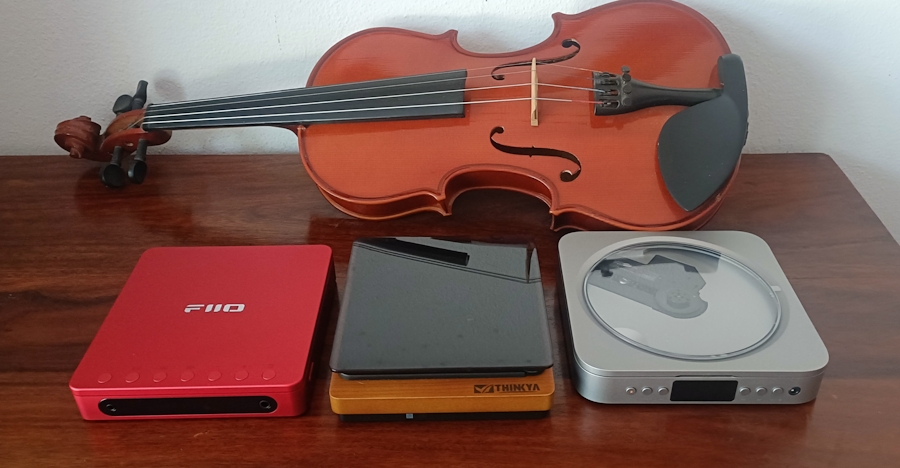
The other contenders in this three-way showdown are two newly introduced players with similar pricing and specifications: the Merak from Fosi Audio and the DM13BT from FiiO. In this first instalment, I will focus on comparing their operational features and technical specifications, of which there are many, shortcomings included. The listening tests and sonic comparisons will be covered in the second part of this review.
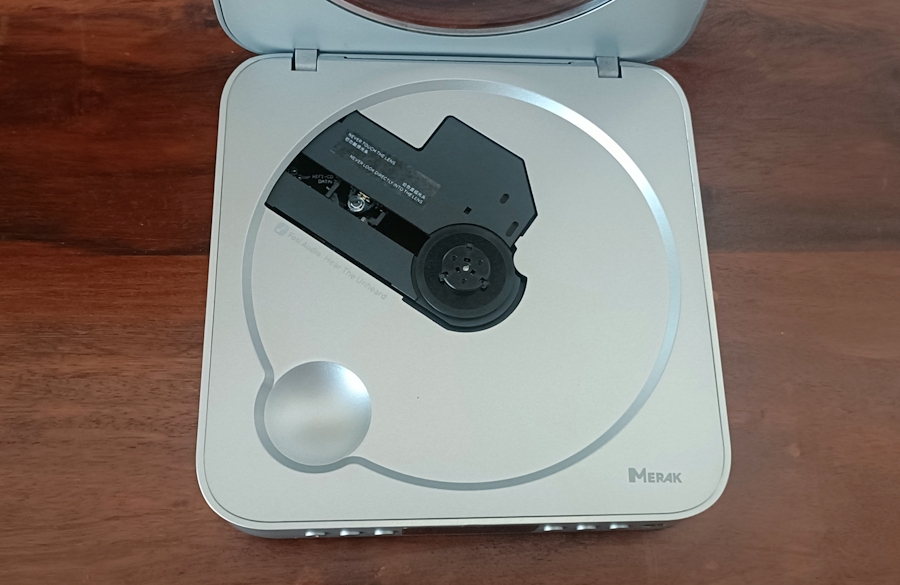
As for the ThinkYa JA310R, I would refer readers directly to my review published a few months ago. Let us therefore begin with the Fosi Audio Merak. Its CD transport, the same used on the ThinkYa JA310R, is the Samsung CMS-M93, capable of playing standard CDs as well as CD-R/CD-RW discs containing FLAC, WAV, WMA, AAC and MP3 audio files. Reading the TOC (Table of Contents) is not particularly quick, although track-skipping performance is noticeably better. USB flash drives and memory cards to be connected via a USB input for playback of MP3, WAV, FLAC, AAC, APE and WMA files.
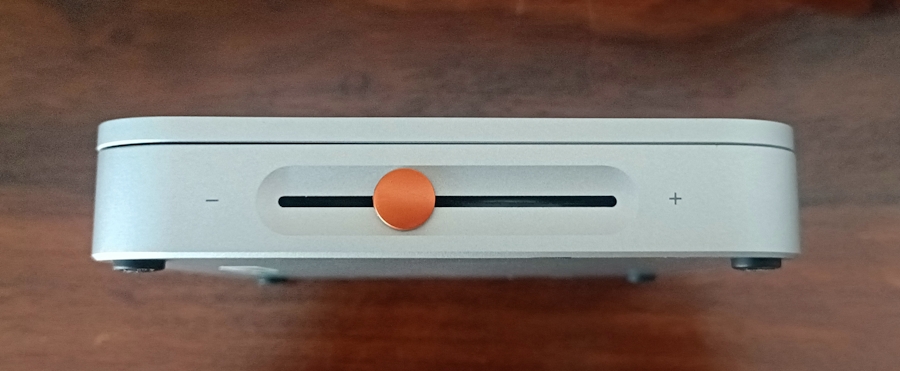
In terms of outputs, the unit features both a LINE OUT for direct connection to an amplifier and an optical digital output for use with external DACs or active loudspeakers equipped with digital inputs. A useful 12V trigger output is also available, allowing synchronized power switching with other Fosi components such as the ZD3 and ZA3. There is a front-panel mini-jack headphone output, rated at 210mW + 210mW into 32Ω with THD+N below 1%. A convenient remote control duplicates all commands available on the unit itself. Output level can be adjusted for the headphone output via a copper-coloured slider on the side panel, while the line output unfortunately operates at a fixed level.
Another interesting feature is the ability to extract audio files from CDs and record them directly onto a USB flash drive at the touch of a button. CD playback can be stopped either by pressing the stop button on the remote control or simply by opening the lid itself, which is transparent so that the spinning disc remains visible. Bluetooth connectivity is not provided. A comprehensive and easy-to-read display rounds out what is clearly a well-designed human-machine interface.
From a hardware standpoint, the Merak employs three main chipsets: an SC6137D for USB audio management, a Cirrus CS43131 DAC for digital-to-analogue conversion, and finally a Texas Instruments TPA6120 operational amplifier for headphone drive duties. An internal ESP buffer, which can be disabled, provides up to 60 seconds of playback protection to prevent audio interruptions caused by shocks or vibration.
The external power supply (not included) can be any good-quality smartphone charger. The package does include a USB-A to USB-C cable. No internal battery is fitted, therefore genuinely mobile operation is only possible when using a suitably capable external power bank.

The similarly priced contender I selected for comparison is the FiiO DM13BT, another feature-packed machine, though unfortunately lacking the convenience of a remote control. The controls located on the player itself are not particularly ergonomic, and the printed legends, at least on the red version I'm testing are practically illegible.
The CD transport is exactly the same of the Fosi Merak and the ThinkYa JA310R, the ubiquitous Samsung CMS-M93. It can play FLAC / WAV / WMA / AAC / MP3 files from compatible discs. CD ripping to external USB storage (FAT32) is also supported. In this case, however, the USB port cannot be used for audio playback as it can on the Merak. Its sole purpose is recording audio from CD to a USB flash drive or USB hard disk. Once again, TOC reading is not particularly fast, whereas track access is commendably quick. Volume control is adjustable in no fewer than 99 steps and affects both the headphone output and the LINE OUT. An ESP buffer mode is also provided to minimise skipping during portable use or when used in a car.
Compared with the Merak, both of these “mobile” applications are easier to accommodate because the DM13 incorporates a rechargeable 3750mAh lithium-ion battery. As a result, it can operate completely disconnected from the mains supply while used at home. The charger is not included, but any decent smartphone power adapter will do the job. In doing so, one achieves the audiophile dream of a component operating free from the allegedly harmful influence of the AC mains 😉
There are two headphone outputs on the front panel: a standard 3.5mm single-ended mini-jack and a 4.4mm balanced output, with naturally very different power capabilities. The former delivers 180mW + 180mW into 32Ω with THD+N < 1%, slightly lower than the Merak but still more than adequate, while the latter provides a substantial 660mW + 660mW into the same 32Ω load, again with THD+N < 1%. Surprisingly, the line outputs are also available in both single-ended and balanced configurations, while digital connectivity includes both optical and coaxial outputs, the latter available via a supplied adapter.
Compared with the Merak, the DM13BT also offers aptX High-Resolution Bluetooth connectivity (a version without Bluetooth is available as well, identifiable by the absence of the BT suffix). On the rear panel there is a D.Mode (Desktop Mode) switch that allows the internal battery to be charged while operating from an external power supply. The attractive display provides all essential information, including remaining battery charge and volume level. CD playback features include single-track repeat, full-disc repeat and even the ability to memorise a favourite track.
In terms of size and weight, the two CD players are extremely similar. The package includes both a USB-C to USB-A cable and a mini-jack-to-female-RCA adapter for the coaxial digital output. The DM13 is available in numerous colour options, whereas the Merak is offered exclusively in silver.
From a technical standpoint, the FiiO DM13 employs a sophisticated conversion stage based on a pair of Cirrus CS43198 DACs. This is essentially the same converter architecture employed in the Merak, albeit implemented as a dedicated DAC chip without the integrated headphone power stage. Headphone amplification duties are entrusted to the SG Micro SGM8262 dual-op-amp.
As for the published technical specifications, which are in reality very similar between the two players, I shall simply refer readers to the manufacturers' websites or those of their respective national distributors.


These are two similar, but not identical, CD players. The Fosi Merak lacks Bluetooth connectivity, has no coaxial digital output (optical only), and no balanced line output (single-ended only). Moreover, and this is genuinely a bug that needs fixing, it is not possible to adjust the line output level, only the headphone output. As a result, connecting it to active loudspeakers without remote control or directly to a power amplifier can range from annoying to downright impossible. Finally, it lacks an integrated battery, making it a portable player only “up to a point” 😉
On the other hand, the FiiO DM13, despite offering all these features, lacks what is, in my opinion, an indispensable remote control if it is to be used in desktop mode. To make matters worse, the small physical buttons located on the top of the player have virtually illegible markings (at least on the Red version under review) and require some time before one can learn to operate them by touch alone. The human-machine interface is therefore decidedly inferior and definitely in need of improvement. Neither player is particularly quick at reading the TOC, as the CD transport is probably the same in both units (I preferred not to open them up).
From an operational standpoint, I would have appreciated a combination of the strengths of both machines. To be clear, one digital output is enough; the coaxial output is fairly pointless in this context, as is the balanced line output. A remote control is a must and, for genuinely portable use, so is an integrated battery. Bluetooth connectivity is useful, as is the ability to play files from a USB flash drive. CD ripping, available on both machines, frankly strikes me as a feature nobody really needs any more. A variable line output is another absolute must. In short, for different reasons, neither player left me completely satisfied. Paradoxically, at a fraction of the asking price of these two players, the modest ThinkYa JA310R had impressed me more. It offers everything is needed (digital output, remote, USB, Bluetooth) for just €70, and makes use of the very same CD transport. From a sonic perspective, however, there will be some interesting insights in the next instalment.
The Fosi Audio Merak and the FiiO DM13BT are two players selling at essentially the same price point, yet offering rather different feature sets. From an electronic design perspective, however, there are no dramatic differences between them, apart from the different op-amps used in their headphone output stages. Will they sound the same? And will they outperform the small and affordable ThinkYa JA310R? We will find out in Part II of this comparative review.


DISCLAIMER. TNT-Audio is neither a shop, nor a HiFi company or a repair laboratory for HiFi components. We don't sell anything. It is a 100% independent magazine that neither accepts advertising from companies nor requires readers to register or pay for subscriptions. We do not use affiliate links. If you wish, you can support our independent reviews via a PayPal donation. After publication of reviews, the authors do not retain samples other than on long-term loan for further evaluation or comparison with later-received gear. Hence, all contents are written free of any “editorial” or “advertising” influence, and all reviews in this publication, positive or negative, reflect the independent opinions of their respective authors. TNT-Audio will publish all manufacturer responses, subject to the reviewer's right to reply in turn.

© Copyright 2026 Lucio Cadeddu - editor@tnt-audio.com - www.tnt-audio.com
[ Home TNT-Audio | Staff & Contacts | HiFi Playground | Listening tests | DIY & Tweakings | Music & Books ]