
[ Home | Staff & Contacts | HiFi Playground | Listening tests | DIY & Tweakings | Music & Books ]
Product: DIY SET6080 Amplifier
Manufacturer: You dear reader
Original parts supplier: World Audio Design - still trading but link may not open as is shown often as www without latest https prefix
https://www.world-designs.co.uk/
this url only seems to open using duckduckgo so that is what the plebs must use, while lurking stage left
Contact:sales@world-designs.co.uk
Price: Your mileage WILL vary - it's all up to you what parts you specify
Author: Mark Wheeler - TNT-Audio UK
When: Created, modified, modified again & again, & again and continually reviewed: 1997- today, 2025
This DIY series was planned as a trilogy and soon grew to 4 parts during Episode 1. As we embark on Part 3 the trilogy has grown to 5 parts. In Part 2 we decided on and built and tested the power supply. Now in Part 3 we finally take a look at the circuit design and what it is about this particular Tim de Paravicini design that attracted your Old Scribe. The pages of Sound Practices were stuffed with purist small triode power amplifiers featuring various 2A3, 6N7, 300B medium power triodes. Most of those were far more purist than this Tim de Paravicini design. The Sound Practices crew eschewed global feedback, cascode pairs, cathode bypass and bypass caps, all of which feature in this design. However, this design will work without the global feedback and your Old Scribe likes a stiff cascode. “Fnarr fnarr!“ snort puerile plebs, stage left
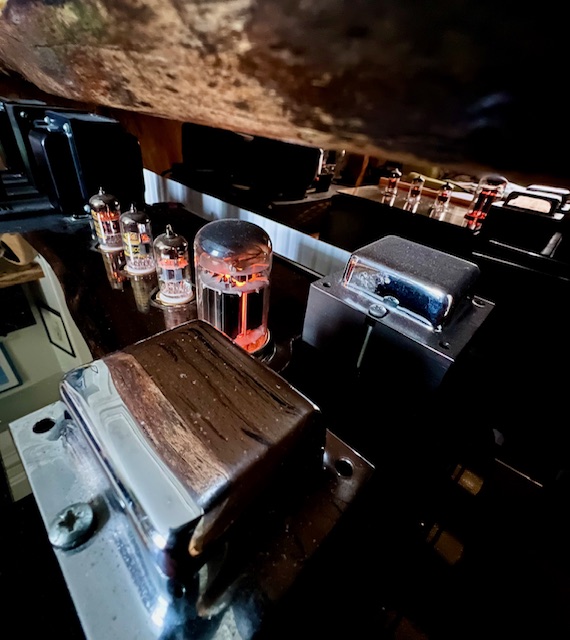
The loudspeakers are driven directly by the output transformers (OTX) in an active set up and in the top photo you can see the midrange and treble transducers, either of which could be the recipients of the stream of electrons from the output transformer secondaries. Remember, The glass is only there to drive the iron. This iron is a silicon steel laminated oversized core (they do not get particularly hot even when driven hard) because SET's do not cancel their plate voltage like push-pull do; therefore the output transformers need massive cores for a 4W amplifier.
The output transformer primary coils are swung by a 6080 double triode valve (tube). Make sure that you order OTX suitable for single-ended use. These 6080 valves were not originally designed for Audio output use but Tim de Paravicini had identified that chucking over 200 V at the plate (anode) would you get enough drive for this purpose. The B+ rail is actually at 260 V in this published circuit, which has had no effect on valve life in this example, still at spec after 30 years use on the original Chelmer branded valve. In this mode, with this output transformer (hereafter 'OPT' or 'OTX') the total distortion at 1W output is about 1% and this is dominated by harmonious 2nd harmonic distortion. It takes clipping to generate any audible 3rd, even when working full range. Indeed, even when this amplifier is working hard from 20Hz to 20kHz, we're rarely drawing more than the first Watt. In the Euterpe loudspeaker project the little 6080 amplifier was destined for duties no lower than 200Hz in any possible future generations.
The 6080 double triode is driven by the ever popular ECC88 (so plenty available for tube rolling) in a cascode configuration. In demonstration experiments with both valve and solid state amplifiers, your Old Scribe has witnessed that some of the most musical results come from an interesting combination of regulation approach. This cascode stage is the valve equivalent of tightly gripping the valve doing the work. The driver supply is regulated by its cascode condition but the output valve can swing with abandon hooked directly to the power supply storage capacitors.
Output stages with very generous unregulated, power supplies, seem to bounce along tunefully in a way that stiffly regulated power supplies seem to sit on. This is all unexplained subjective mumbo jumbo but an observation reported by many experimenters, including your Old Scribe. Conversely, the best results from such output stages seem to come when driven by highly regulated driver stages. Your Old Scribe has observed this demonstrated with solid state and valve circuits.
One hypothesis is that the driver stage could be modulated by power supply sag during times of output stage high demand if it shares an unregulated supply. This cascode driven 6080 circuit is similar in principle to the regulated driver supply in solid state circuits because the 'upper' triode (as it appears in the schematic) regulates the operating point of the amplifying triode. The Radiotron Designers Handbook is one of the best learning resources for those interested in valve/tube circuit design. Start learning there rather than a search engine.
The input valve of Tim de Paravicini's SET6080 design is the equally popular high gain ECC83. This may look like a four stage amplifier, but that cascode driver is effectively one stage. The odd number of stages means that this is an inverting amplifier; either the input or the output must be wired out of phase to maintain phrase integrity. For system earth simplicity, reversing the loudspeaker terminals is easiest, especially as we're going to be playing with OPT taps for output impedance and feedback later.
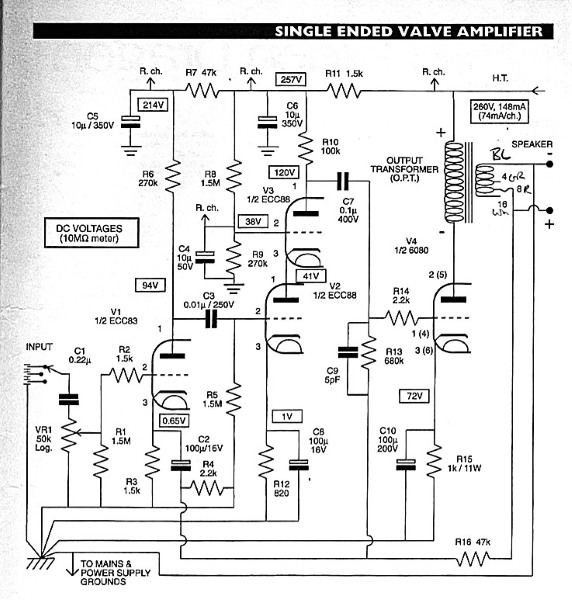
All the valves (tubes) in the circuit have cathode bypass, capacitors. Feedback obsessives might object to this, but this is current feedback not voltage negative feedback (NFB). We're going to try voltage negative feedback from the output transformer anyway, so the anti-NFB league can save their screams for later.
One reason why some folks might object to cathode bypass capacitors is that the quality of these capacitors is crucial. Poor ESR, non linearity, microphony etc will affect the stability of that amplifying device. Fortunately, your old scribe had access to, and stocks of, the low-voltage high value types needed here. This includes genuine Black Gate capacitors and other top quality Rubicon gems.
At the time of building this SET6080 your Old Scribe, tended to regard Wondercaps as a reasonable value compromise for bypass and small values. Sadly the subsequent InfinicapsTM are more obviously 'voiced' and more obviously expensive, so you'll have to find your own brands. Once the basic breadboard was done, all the capacitors larger than 10µ were routinely singly bypassed. Although experiments conducted by a trusted source (a respected technical press author and electronics designer) had established the stacked 1/100 bypass rule, I could only justify a single bypass after my own experiments, on cost grounds if nothing else. All the series capacitors used were Wondercaps. There is a tiny silver mica cap on the grid leak resistor (R13) of the 6080 for stability. R16 is the global feedback resistor and can changed to a higher value to reduce feedback or the connection ignored for zero feedback in some contexts. With a complex passive crossover full range loudspeaker, we might anticipate NFB stability problems, but that little 5pf (C9) bypass on the local feedback apparently sorts this out. As shown there's a theoretical bandwidth of 9Hz to 64kHz, and we could replace the input cap with a smaller value to block 50Hz/60Hz in an active set up. If using this amplifier as a tweeter only amplifier atop a big driver using the bass-mid's natural HF rolloff (as your Old Scribe did with the Hammer Dynamics project), that first capacitor can be substituted to create a suitable high-pass filter. The 50kR and 1.5MR resistors were replaced by a 250kΩ Holco H2 resistor.
You will recall from Part 2 that when your Old Scribe built and tested the power supply, the bridge rectifier was replaced by fast recovery diodes. The audio circuit was breadboarded. Anticipating the main role of the SET6080 will be in a high pass position in an active system but also used occasionally full range to review high sensitivity full range loudspeakers meant choosing input R and DC blocking capacitor to suit both. Not knowing what active crossover or line level passive crossover might be employed, the input resistor was raised to 250k to minimise the effects of long cables or high source impedance. Once tested it was dismantled and transferred to the chosen case. Sadly it was now not working on one channel and your Old Scribe could not find the fault. At this point a fresh pair of eyes was needed and an electronic engineer friend was recruited. There were two connection errors, hence your Old Scribe's bewilderment and the engineer's rapid solution with better trained more experienced eyes. Never be afraid to acknowledge our limitations and ask for help. An image of this snagging operation has been your Old Scribe's TNT-audio bio pic for over 30 years.
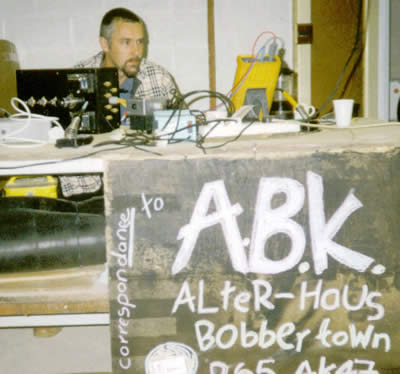
“What?!?“ challenge plebs, stage left, “A wandering signal? Either the Old Scribe is losing his marbles, or sacrificing common sense for mediocre litearary style“
Omitting the input potentiometer and selector switch because this is purely a power amplifier in this build, the input signal is divided across R1 (which could be anything from 250k up if you prefer to minimise cable effects, or as low as 50k) and R2. C5 is the local power supply capacitor for the ECC83 so a good quality film type with a high quality bypass is worth the investment. The same applies to C6.
Zero negative feedback obsessives will wish to omit R16, and if that obsession extends to current feedback those so inclined would have to omit C2, C10 and R4, but TNT-Audio will not be responsible for your loss of gain and possible other side effects.
V3 holds V2 in a well regulated position. C3 and C7 are DC blocking capacitors in the signal path and being tiny we can splash out on whatever couture brand takes our fancy. Try substituting different brands and ask ourselves if we can really hear any difference. It is one of the locations I have used to test capacitors in reviews you will have read before. More important than anything else is keeping the noise down. This is achieved by star earthing (star grounding in some uses of English) including the copper sheets used as screening in the Torlyte or other wood case. Point-to-point wiring with the shortest possible path is best, no matter how much messier it looks than a Quad II. Avoiding bundled or nearby parallel wires helps reduce the possibility of mutual induction. Minimising hookup wire lengths reduces the possibility of inductance or capacitance causing problems. Hence connecting the lead out of C3 directly between the bases of V1 and V2 is a good idea if possible, for example, in the final build.
Remember that there are lethal voltages at many points in this circuit. If you have never built an electronics kit before, this may not be the place to start. Do feel comfortable asking for help, DIY audio can be a great social activity and reduces the likelihood of mistakes as long as alcoholic drink is not involved!
Getting this project from the “That seems like a good project” stage to the breadboard stage was a steep learning curve. Applying various experiments to the breadboard circuit stimulated another set of new neural pathways in the Old Scribe brain. On hearing how good the prototype sounded stone cold demonstrated the potential of this project.
Transferring the rats nest of point-to-point wiring to the case was equally effective at demonstrating that pride comes before a fall. We should always acknowledge our limitations and ask for appropriate help in every area of our lives. In Part 4 we look at how it comes together and the evolution of casework, then Part 5 offers more on building, auditioning and further modifying.
![[Love]](../gif/love.png)
![[Donate with Paypal!]](../gif/donate_now.gif)
DISCLAIMER. TNT-Audio is neither a shop, nor a HiFi company or a repair laboratory for HiFi components. We don't sell anything. It is a 100% independent magazine that neither accepts advertising from companies nor requires readers to register or pay for subscriptions. If you wish, you can support our independent reviews via a PayPal donation. After publication of reviews, the authors do not retain samples other than on long-term loan for further evaluation or comparison with later-received gear. Hence, all contents are written free of any “editorial” or “advertising” influence, and all reviews in this publication, positive or negative, reflect the independent opinions of their respective authors. TNT-Audio will publish all manufacturer responses, subject to the reviewer's right to reply in turn.
![[Follow us on Facebook]](../jpg/fb_small.jpg)
© 2025 Mark Wheeler - mark@tnt-audio.com - www.tnt-audio.com
[ Home TNT-Audio | Staff & Contacts | HiFi Playground | Listening tests | DIY & Tweakings | Music & Books ]