[ Home | Staff & Contacts | HiFi Playground | Listening tests | DIY & Tweakings | Music & Books ]
Product: DIY SET6080 Amplifier
Manufacturer: You dear reader
Original parts supplier: World Audio Design
Contact: sales@world-designs.co.uk
Price: Your mileage WILL vary - it's all up to you what parts you specify
Author: Mark Wheeler - TNT-Audio Scotland
When: Created, modified, modified again & again, & again and continually reviewed: 1997- today
DIY enables us to fit our audio priorities exactly rather than have to fit someone else's idea of what makes the best stereo performance. DIY allows us to design from scratch or adapt someone else's tested design to our own priorities. DIY is unlikely to save us money. DIY takes up a lot of our time. But DIY audio is absolutely the most satisfying part of our hobby. DIY audio is very good for our brains, the learning process kindles new neural pathways and the building process reinforces those new pathways.
This is the fourth part of the trilogy (and kudos to Douglas Adams' precedent for enabling the trilogy to extend beyond the traditional three parts) in which we concentrate on how the amplifier is built. In Part 1 we introduced the ideas behind this scratchbuilt amplifier. In Part 2 we explored the requirements, design and execution of the power supply and in Part 3 we finally got a look at the audio circuit. In Part 3 we thought about the original designer's priorities and how closely they match our needs for this particular application. This is a key advantage of DIY.
In this, Part 4 of the SET6080 trilogy (it was to be a trilogy but like Topsy it growed) we examine the casework choice, however eccentric that might be. Part 5 will be a return to this amplifier to explore some of the variables and report on the sound; there'll be a surprise disagreement with the original magazine assessment.
Various of the more out there designers, like Hiroyasu Kondo, founder of the original Audio Note company, Japan, choose copper for amplifier chasses after much experimentation. Leo Fender even built the early Champ amps with copper chasses. Several of the Sound Practices authors and designers recommended copper too. So the SET6080 was built on a copper sheet mounted inside the top of a used RATA Torlyte box purchased in a bargain sale. Your Old Scribe's various experiments certainly indicated that steel sides parallel to circuit boards could induce noise and that no chassis at all, or a wood chassis, were better than aluminium which in turn was better than steel. Internal layout transpires to be crucial in maximising transparency.
As described in my very first piece for TNT-Audio, the SET6080 benefitted from a RATA Torlyte case. Many years ago Russ Andrews had a clearance sale of Torlyte cases and sheets that had been drilled for prototypes. These were perfectly functional and being sold for a tiny fraction of the usual retail price, less even than similar sized sheets of balsa wood or cheap chipboard/mdf boxes. Your Old Scribe bought the lot. These have been extensively used in the various vibration control experiments described in these pages and many more experiments besides.
![[Box Clever with inner copper]](../jpg/set6080_inner_copper.jpg)
The interior of the Torlyte case is partially lined with star earthed copper sheet. Hiroyasu Kondo of the original Audio Note (Japan) experimented with various case materials including aluminium, steel and copper. The legendary Ongaku was launched in 1989 with copper casework as a result of this research. A copper chassis helps improve sound compared to aluminium or steel they found, claiming that copper improves “liveliness”, reduces “haze” and extends top end clarity. The subjective effect of this eddy current free, non ferrous, low hysteresis box compared with steel is greater clarity in this application compared with a 2U steel rack case.
For several years this copper lined Torlyte casework served sufficiently well when the SET6080 served as a full range amplifier while your Old Scribe conducted various experiments with global negative feedback (hereafter ‘NFB'). Experiments were conducted using various loudspeakers of varying sensitivity and passive crossover complexity. Look out especially for a future article about a Tuned Quarter Wave Pipe 97dB/2.83V linear impedance characteristic monster project using Hammer Dynamics parts. You might get the chance to read about others too. Those experiments also extended to the SET6080 directly connected to drivers while serving purely as a midrange amplifier and purely as a treble amplifier too. Results of those experiments were quite different, proving once again that context is everything.
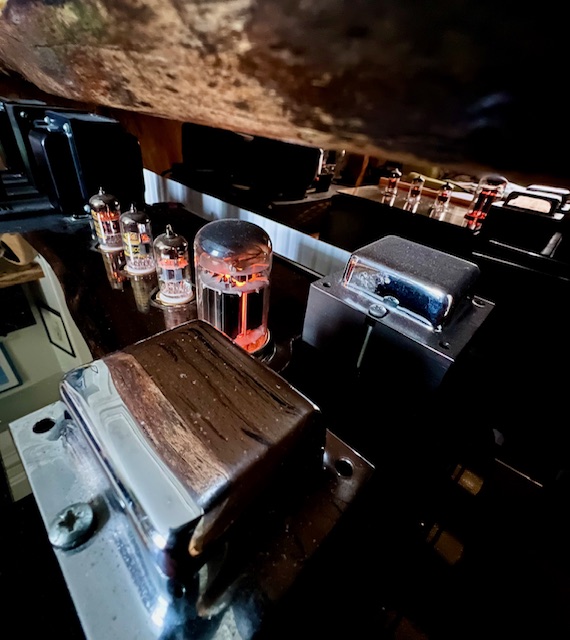
On moving house the same room is used for the main audio system and the primary living room. Now that the NFB experiments are closed, the SET6080 casework does not have to be rapidly opened and closed, nor left open while running. Having identified the synergy with the (now obsolete) ERaudio SpaceHarmoniser this became part of the new version of the case after a few experiments. One of the larger €250 planks was cut longitudinally to create two pieces. One piece is the perfect width to create a baseboard for the amplifier-transformer assembly and the remaining piece is perfect as a front panel concealer of the utilitarian Torlyte box and the mains transformer section. There is convenient access to the mains circuit breaker. Further experiments were undertaken using an inductor near the output transformers to measure any field around the mains transformer. These resulted in the mains transformer being mounted at 45°. The transformer sub-assembly is compliantly mounted to the ERaudio SpaceHarmoniser and the Torlyte amplifier case is glued and screwed to the ERaudio SpaceHarmoniser.
Internal layout probably matters more than than the screening or hysteresis properties of the box. Point to point wiring is used with enough slack for servicing and nothing parallel to anything else. Most of the internal hookup wire is Kimber or multistrand silver-plated copper (both probably PTFE insulated) left over from another project experimenting to find out if hookup wire is audible. Gauges are chosen to suit circuit location and wildly over specified for current.
The mains transformer (hereafter mtx) was originally (for over a decade) perched externally on 4 Brightstar IsoNodes. External mounting is to minimise hum induction. Mounting on Isonodes is to minimise vibration effects. The mtx is attached to it's own little cast aluminium box which includes a low contact resistance circuit breaker/mains switch, to function as both fuse and on/off switch. Care over mains induced noise is more crucial as a treble amplifier in an active system because it is post-crossover and therefore 50Hz/60Hz (and multiples thereof) hum goes directly to the tiny tweeter wires. It is also an opportunity to keep any mtx vibration away from the output transformers (otx) and microphonic passive components; despite some theoretical claims to the contrary, many passive components are microphonic.
Initially the transformer and amplifier were entirely separate but hardwired. The recent rebuild has the two sections permanently mounted on a large ERAudio SpaceHarmoniser plank. This just makes it easier to move about with no noticed effect on sound quality. It is also less unattractive, although still not a thing of beauty worthy of the Bauhaus.
![[Cleverer boxing]](../jpg/set6080_boxed_cleverer.jpg)
Most auditioning was conducted full-range during all the R&D experiments and there'll be more details of how the SET6080 sounds in Part 5 of this trilogy.
“Part 5 of a Trilogy?!?” squeak incredulous plebs, stage left, “Does the old fool have the faintest idea what ‘trilogy' means?”
That the planned trilogy grows to five parts is a perfect metaphor for all DIY audio. Whatever cost we anticipate, we should double the money. Whatever design and build time we anticipate we should quadruple the hours.
Specific tests were also undertaken in the high frequency role. Based on the driver's impedence curve, the SET6080 output transformer tap (4Ω) was chosen and NFB (c6dB) was set to suit the Focal TD120TDX (unshielded version) tweeters in use in the Euterpe system (2.4kHz up). These settings work equally well with the ESS Heil Air Motion Transformers that deserve a regular airing also from 2.4kHz upwards. The ESS have quite a forgiving impedance characteristic compared with typical domes and can manage without any NFB. The Focal is a nominal 6Ω device dipping no lower than 5Ω throughout its working bandwidth and there are many nominal 8Ω devices dropping way lower. Always choose the output impedance tap that most closely matches the minimum impedance, not the nominal impedance, of the driver.
From breadboard to final iteration there has been no drop in sound quality. It is often a builder's experience that the breadboard circuit sounded better (always from memory of course) than the fully stuffed case. This is often because steel or aluminium panels are interacting directly or indirectly with circuit boards and the closer layout of the components. All components can be affected including transformers/inductors and also everything can affect everything else. The closer proximity of parts in a compact and bijou box can also contribute to reduced sound quality.
“This is subjectivist drivel!” Challenge Plebs, stage left, “What evidence is there for this kind of phenomenon?”
There are these experiments conducted by your Old Scribe, among many more:
In part 3 we looked at the audio circuit, which tends to be what most manufacturers foreground in advertising. In Part 2 we thought about power supply and it's unique contribution to a mid/treble amplifier and now we have thought about holding it all together in a box. In Part 5 of this trilogy we will listen to this amplifier in numerous contexts over a period of 30 years!
We will compare it with every amplifier that has ever been reviewed by your Old Scribe. In monetary terms this ranges from the T-amp to other DIY amplifiers whose parts cost exceeds the SET6080 many times over.
We will also notice what various changes sound like.
We will explore how different contexts affect the value of the performance.
I'm informed by World Audio Design that their website is at www.world-designs.co.uk. They also confirm that it is out of date, but that they stick to published prices except for valves (some of which are out of stock anyway).
![[Love]](../gif/love.png)
![[Donate with Paypal!]](../gif/donate_now.gif)
DISCLAIMER. TNT-Audio is neither a shop, nor a HiFi company or a repair laboratory for HiFi components. We don't sell anything. It is a 100% independent magazine that neither accepts advertising from companies nor requires readers to register or pay for subscriptions. If you wish, you can support our independent reviews via a PayPal donation. After publication of reviews, the authors do not retain samples other than on long-term loan for further evaluation or comparison with later-received gear. Hence, all contents are written free of any “editorial” or “advertising” influence, and all reviews in this publication, positive or negative, reflect the independent opinions of their respective authors. TNT-Audio will publish all manufacturer responses, subject to the reviewer's right to reply in turn.
![[Follow us on Facebook]](../jpg/fb_small.jpg)
© 2025 Mark Wheeler - mark@tnt-audio.com - www.tnt-audio.com
[ Home TNT-Audio | Staff & Contacts | HiFi Playground | Listening tests | DIY & Tweakings | Music & Books ]