[ Home TNT-Audio | Staff & Contacts | HiFi Playground | Listening tests | DIY & Tweakings | Music & Books ]
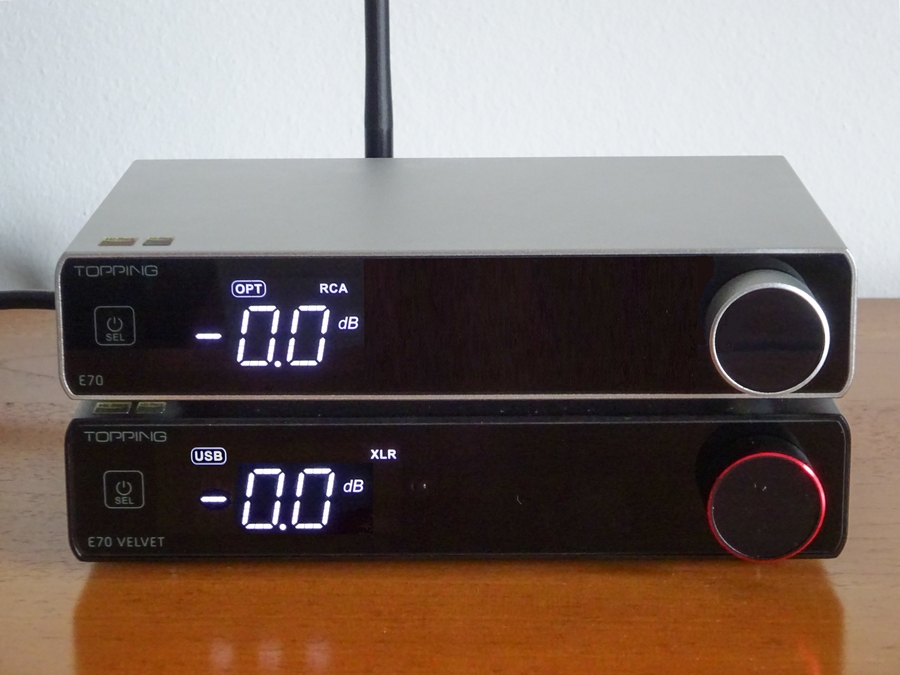
Product: Topping E70 and E70 Velvet
Manufacturer: Topping - China
Price: respectively 279 USD / 279 EUR and 349 USD / 349 EUR on the Topping website
Reviewer: Giorgio Pozzoli - TNT‑Audio Italy
Reviewed: October, 2026
Despite coming from the very same stable, the E70 and E70V serve as a strong counterexample to those who claim that all DACs sound identical.
The impressive versatility of these DACs introduces a significant challenge: there are so many possible combinations of inputs, filters, and digital audio formats that exhaustive listening tests are practically impossible. Therefore, I opted for a streamlined approach: for the listening sessions - which nonetheless extended over a considerable period - I operated both units purely in DAC mode (with volume control disabled) using their default settings (including stock filter selection), connected to the same Raspberry Pi running the latest build of Moode Audio.
Both units require a brief burn-in period before settling into their baseline performance.
From the very first note, the E70 proudly asserts itself as a mainstream DAC, free from any obvious sonic colourations.
The sound is clean, solid, detailed, and precise - perhaps not ultra-high-end, but undeniably above average. The E70 can certainly sing when called upon, though always with composure, never becoming forward or overstated.
With top-tier recordings, the sound-stage is wide, stable, and well-focused, with depth rendered accurately. Individual instruments remain well-delineated and reproduced with natural timbre, if perhaps appearing slightly compact in scale. Only during highly complex passages does finer detail begin to smudge slightly.
However, much of this depends heavily on the quality of the recording being played: this is by no means a forgiving or flattering DAC. It provides an honest reproduction of the source material, showing no obvious inclination to alter or embellish the signal.
It can sound smooth and fluid, with a perfectly polished top end. Yet if a voice or instrument possesses a rough edge, it presents it faithfully.
If the sound-stage is narrow, it will not artificially widen it. If sibilance is present, it will not smooth it over. If a recording sounds dull, it will not add artificial sparkle. If dynamic range is lacking, it will not inject it. It is surprising to realize how vastly different tracks on the very same album can sound.
On the other hand, it does not swing to the opposite extreme: detail retrieval never feels analytical, clinical, or unnatural. Transients are remarkably fast - nearly lightning-quick - yet without ever creating a sense of rush.
In terms of tonal balance, while the frequency response is ruler-flat on paper, compared to many converters - even setting aside NOS DACs - it comes across as distinctly open and extended in the upper registers.
Macrodynamics are solid, while fine microdynamic nuances remain clearly legible.
It also exhibits a keen sense of rhythm, often leaving the listener tapping their foot without realizing it.
Its neutral, precise, and incisive character adapts well across genres: in classical music, woodwinds sound smooth yet appropriately textured when required, pianos render realistically, and brass displays just the right amount of metallic bite. With rock, it shows commendable grit, refusing to back down when energy and aggression are called for. In jazz, it is thoroughly in its element, delivering well-defined performers and an engaging instrumental interplay.
If there are areas open to minor criticism, they lie at the frequency extremes.
The low end is fast and exceptionally well-damped - perhaps slightly too much so: it feels just a touch light, lacking a bit of full-bodied weight. This becomes noticeable primarily when comparing it to DACs with greater bass authority, which is a slight shame; given how engaging it already is, one can only wonder what it might have achieved with a bit more low-end impact.
At the upper end of the spectrum, it remains detailed and precise, as noted; however, I get the impression that it tends to round off the sharpest edges a bit too aggressively. It is not veiled by any means, but it lacks a certain bite - almost as if it deliberately avoids sharpness, even at the expense of absolute naturalness.
AKM's "Velvet Sound" architecture was designed to recreate the acoustic sound-stage of the original recording session right before the listener, "as if you were there." Dissecting how it operates is no easy task, as different tracks produce noticeably inconsistent results and technical documentation remains sparse.
In practical terms, the listener is enveloped in a sonic cloud where most individual instruments, far from being obscured, stand out vividly as distinct musical cameos.
The presentation is elegant, fluid, dense, and rich in harmonic nuances - in a word, seductive. Simultaneously, the DAC demonstrates excellent transparency, precision, and resolution, instantly exposing any flaws in the recording. It is unquestionably a high-caliber performance.
The sound-stage is superb - expansive, rock-solid, and completely cohesive. Every instrument is clearly delineated with its own defined space, remaining firmly anchored in place, even when placed at unusual positions or rendered with absolutely improbable physical scale.
Macrodynamics are solid, but microdynamics are outstanding: the rhythmic drive - the quality that draws you in and keeps your foot tapping - is truly impressive, and not just when the rhythm section takes centre stage.
The low-frequency performance is peculiar: drums are lightning-fast, tightly controlled, yet nicely rounded and full-bodied (occasionally leaning prominent), whereas double bass, if not tightly controlled at recording time, can produce unrestrained low-frequency blooms that spill across half the sound-stage.
In the upper-midrange and high frequencies, the E70V truly comes alive. The interplay among musicians is presented in a captivating manner - a vibrant, sparkling wall of sound from which individual instruments emerge with utmost clarity. This enveloping sound-field wraps around the listener in a thoroughly mesmerizing fashion - delivering a "comfortable and immersive" experience, as AKM puts it - to the extent that one can easily lose sight of the broader musical picture while tracking individual lines.
However, on several recordings, this presentation leaves limited breathing room for the midrange: male vocals, in particular, can sound somewhat recessed, thinned out, and lacking chest resonance. Consequently, when a singer pushes into a belt or growl - as is common in hard rock - the performance can lean slightly thin. Yet on other tracks, male vocals are rendered surprisingly prominent.
Female vocals, particularly higher registers, are well-projected, precise, detailed, and smooth. However, much like its stable-mate, the E70V seems determined to avoid any harshness: passages where one might expect a sharp, incisive edge are softened into a highly refined, polished treble that can ultimately feel somewhat unnatural. In certain instances, this effect extends to instrumentation as well.
From the above, it is evident that signal processing is taking place, though this becomes obvious only on certain tracks. Initially, I struggled to pinpoint the exact nature of these alterations - particularly what was driving the dense, vibrant sound-stage presented before me.
Eventually, I realized that each sonic element - including lead vocals - is rendered with a noticeably larger physical scale than on typical DACs, causing sound sources to expand into adjacent acoustic space or overlap, occasionally (though fortunately rarely) obscuring neighbouring elements.
This recalled a diagram regarding DSP algorithms I had encountered almost by chance on AKM's technical website, which I had initially dismissed as irrelevant. The document, subtitled "Creating sound that captures the senses", makes explicit, albeit passing, mention of Velvet Sound, explaining how digital audio algorithms can achieve "crystal-clear sound localization, an expanded and well-balanced sound-stage, and thundering bass." The document visually illustrates this effect using two revealing graphics: the first, without processing, depicts a sound-stage with small, widely spaced musicians; the second, with processing enabled, displays the same scene populated by significantly larger images occupying the entire soundfield.
On the consumer-facing Velvet Sound website, AKM notes that its design choices were evaluated by professional musicians to verify fidelity against live performance sessions. This suggests that the processing tuning was benchmarked against specific live acoustic environments.
Anyone who has attended an unamplified live acoustic session knows that - contrary to studio playback norms - instruments rarely sound pinpoint-isolated, sound sources are not point-like, and drums naturally dominate the room. Thus, the algorithmic choices are rooted in sound principles.
By repeating many of the tests, I realized that the most natural recordings - those subjected to minimal post‑production processing (such as live sessions captured with just a few microphones) - which often come across as somewhat flat and lacking drive, are reproduced on the E70V with remarkable liveliness, realism, and presence. I would say almost magical, without the slightest hint of artificial enhancement.
Conversely, heavily multi-tracked studio recordings featuring artificial mixing decisions reveal their limitations: double basses balloon across the sound-stage, vocalists feel unnaturally close, and grand pianos exhibit oversized keyboards. In these cases, post-production likely introduced spatial enhancements similar to Velvet Sound, making the additional processing feel heavy-handed.
These observations account for the variable results encountered across different recordings. Unfortunately, because the vast majority of commercial releases belong to the latter category, the outcome can be a mixed bag.
Then again, developing an algorithm optimized for every style of mixing is probably impossible.
Given its balance of features and performance, the E70 is a versatile DAC with broad appeal.
It delivers a balanced, neutral, precise, and highly detailed sound. While slightly less velvety than the E70V, it offers a bit more bite, punch, and, above all, transparency without a hint of artificiality.
Compared to the E70V, it provides a more traditional, mainstream sonic presentation - lacking fancy tricks, but performing at an exceptional level, especially considering its price point. Costing roughly 20% less than the E70V, it represents a compelling value proposition.
It can be a welcome solution for systems with loose or boomy bass, helping bring low frequencies back under tight control.
From a bench-testing perspective, it stands on equal footing with the E70V - and according to published third-party measurements, even marginally ahead (though squeezing out those last few fractions of a dB in a home lab is practically impossible).
As for the E70V, listening to it is an absolute pleasure. On numerous occasions, I caught myself forgetting to take review notes, simply sitting back to enjoy the music - a testament to its engaging nature. For a music-first listener unconcerned with absolute purism, its seductive presentation may well prove irresistible.
For audiophiles committed to absolute neutrality, I still recommend giving it a listen; it offers a unique sonic experience. Depending on your preferred genres, you may well fall in love with it. However, purists should consider whether they want to spend their time enjoying the presentation or questioning how much of the magic is on the recording versus the algorithm.
The final verdict? A balanced trade-off: both models have distinct strengths and minor shortcomings. The E70V offers greater refinement and character at a higher price, whereas the standard E70 delivers outstanding honesty and value. Given their contrasting sonic signatures, choosing between them comes down to personal taste.
Our thanks to Audio Azimuth/Playstereo for providing the E70 review sample.
Back to the Part I Back to the Part II
Other Topping products we reviewed: L30 II headphone amp & preamp, A50S headphone amp & preamp, PA3 integrated amp, MX3 integrated amp, DAC & headphone amp.


DISCLAIMER. TNT-Audio is neither a shop, nor a HiFi company or a repair laboratory for HiFi components. We don't sell anything. It is a 100% independent magazine that neither accepts advertising from companies nor requires readers to register or pay for subscriptions. We do not use affiliate links. If you wish, you can support our independent reviews via a PayPal donation. After publication of reviews, the authors do not retain samples other than on long-term loan for further evaluation or comparison with later-received gear. Hence, all contents are written free of any “editorial” or “advertising” influence, and all reviews in this publication, positive or negative, reflect the independent opinions of their respective authors. TNT-Audio will publish all manufacturer responses, subject to the reviewer's right to reply in turn.

Copyright 2026 Giorgio Pozzoli - giorgio@tnt-audio.com - www.tnt-audio.com
[ Home TNT-Audio | Staff & Contacts | HiFi Playground | Listening tests | DIY & Tweakings | Music & Books ]