[ Home TNT-Audio | Staff & Contacts | HiFi Playground | Listening tests | DIY & Tweakings | Music & Books ]
Product: Topping E70 and E70 Velvet
Manufacturer: Topping - China
Price: respectively 279 USD / 279 EUR and 349 USD / 349 EUR on the Topping website
Reviewer: Giorgio Pozzoli - TNT-Audio Italy
Reviewed: September, 2026
Topping was founded in 2008 and over time has earned a prominent position in the digital-audio landscape. The company operates in both the consumer and professional sectors and produces a considerable number of digital and analogue devices, including DACs, amplifiers, headphone amps and USB isolators. TNT has already reviewed a number of their products.
Within the DAC category, Topping offers several product lines: according to a not-so-recent statement from the company, the E series should focus on compactness and performance optimisation relative to cost (i.e., the budget line), while the D series should be more specialised (the top line), with other series being even more specific. In practice, the distinction is not particularly evident from the catalogue: both series include very affordable components, but the D series, consistent with the statement, reaches higher price points.
The Topping E70 (E70 hereafter) is not a recent model and has a modest price, yet it ranks among the best digital-to-analogue converters in terms of noise and distortion measurements, placing itself close to far more expensive reference units. It uses the ES9028Pro, an excellent ESS converter.
The E70 Velvet (E70V hereafter), the new version, currently represents the top of the E series, followed closely by the E70, which still appears in the catalogue - likely because, given the price difference, it occupies a different market segment, but perhaps also because it has a distinctly different sonic signature.
The E70V adopts AKM's Velvet Sound Verita technology. Several documents on AKM's website describe its goals: "enhancing digital performance by reducing noise and distortion," to achieve "the reproduction of a natural, pleasant and immersive sound space": plenty of marketing hype, admittedly, although grounded in concrete engineering - as we shall see.
It uses a two-chip DAC architecture, the AK4191EQ and AK4499EX, AKM's flagship components.
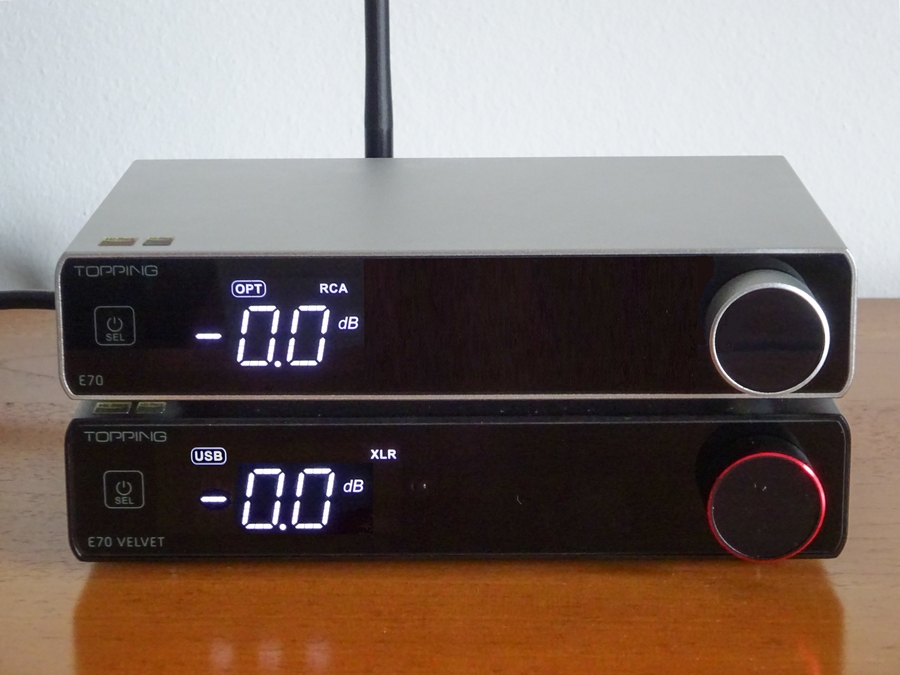
Externally, the two units differ only by a small inscription at the bottom left of the front panel. Both can be used as external converters for PCs or streamers, as standalone DACs in hi-fi or home-theatre systems, and even as preamplifiers, since in the dedicated mode the output volume can be controlled along with the selection of digital inputs.
Given that their bench-test performance is absolutely excellent, they can also be used as signal generators for audio measurements.
The converters arrive in a sturdy and elegant black rectangular box, with the Topping logo at the top left. The box is fully sealed in shrink-wrap. Inside, both the bottom and the lid contain pre-formed foam structures that completely secure the DAC. The remaining space is occupied by two black cardboard boxes containing the accessories. According to European standards, the packaging is almost excessive for a product in this class, though not unusual for Chinese manufacturers.

Both units appear as compact rectangular enclosures (200×138×44 mm) with a silver or black body and rounded upper edges; on the front panel, always black, there is on the left a multifunction touch button, then a large display that normally shows the output volume but provides various information depending on the operation, and finally on the right a single multifunction knob, marked with a red line on the black version. Two small labels on the top show the Hi-Res Audio and Hi-Res Audio Wireless logos. No MQA logo, as it is not supported.
The display is large - especially relative to the class of the device - and therefore easily readable even from a distance.
Inputs and outputs are on the rear panel: from the left, XLR outputs, RCA outputs, S/PDIF coaxial and optical inputs, the Bluetooth antenna connector, the USB-B port for PC connection; finally, the trigger input/output for coordinated power-on with other Topping components, the mains connector and the power switch.
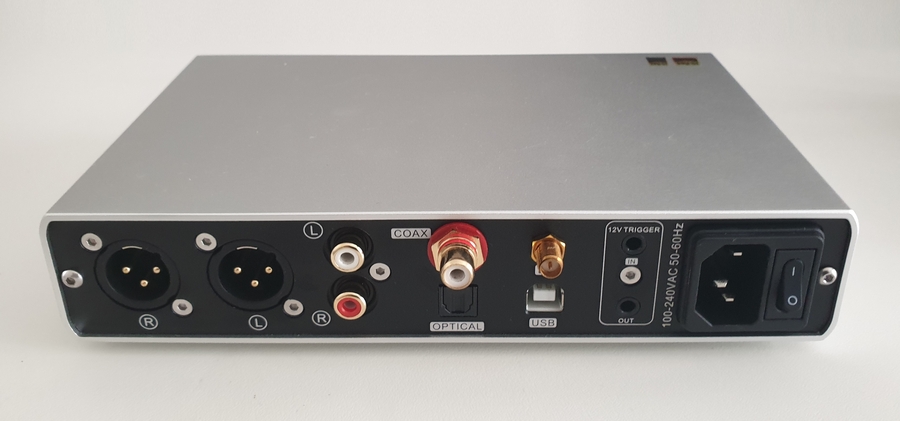
The outer shell and panels feel very solid, and the weight is considerable relative to the size. The four feet are made of fairly rigid rubber and rounded.
The connectors also appear firmly mounted, solid and well constructed.
The package includes, in addition to the E70 unit, a USB-A/B cable, the remote control, the Bluetooth antenna, the power cable (Schuko plug in my case), the manual (a very concise but complete fold-out sheet in Chinese, English and Japanese, also available on-line), and the warranty certificate.
Operation is straightforward in principle. The unit is switched on via the rear power switch and enters standby.
The touch button on the left allows exiting standby (and returning to it with a long press) and selecting one of the inputs: Bluetooth, USB, optical S/PDIF, coaxial S/PDIF. The selected input is shown on the first line of the display with an acronym (BT/USB/OPT/COA) inside an oval. After selection, the type of incoming data (PCM or DSD) is shown on the left and, if the connection is active, its characteristics (e.g., 44.1 kHz for PCM or 2.8 MHz for DSD64) appear in large characters; after a short interval, this information is replaced by the current volume level (or rather attenuation, since the maximum is indicated as -0.0 dB). The display is large and easily readable even from a distance.
Rotate the knob on the right to adjust the volume; press it to select the output: RCA, XLR or both.
The lower-left area of the display also shows a CB indicator, which lights up if channel balance is altered.
The remote control is simple yet specialised and functional. Under normal conditions it allows standby control, input and output selection, volume adjustment (only in preamp mode), channel balance and direct modification of several other options.
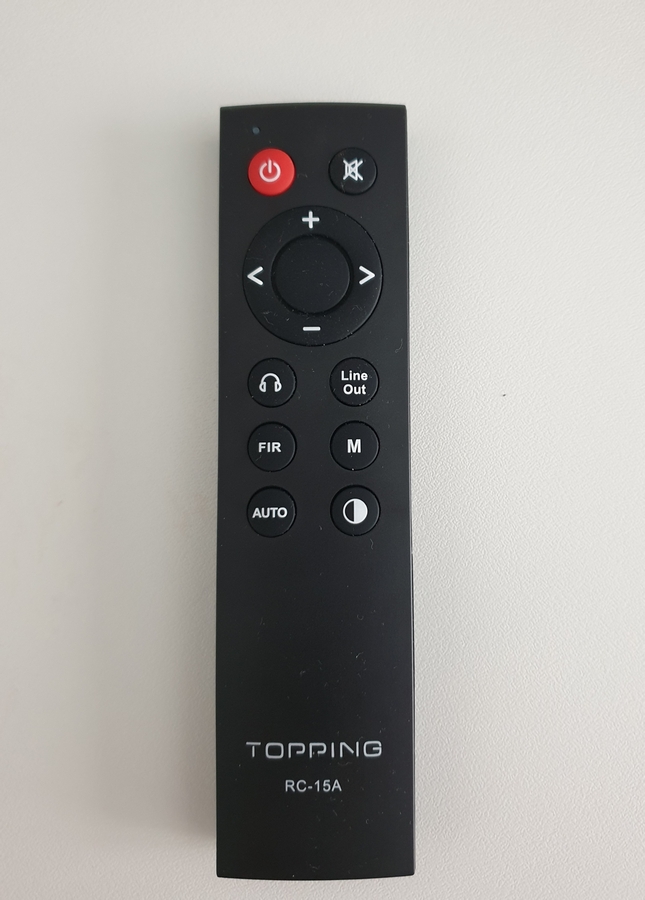
Several additional options are available, some modifiable directly from the remote and others only through the configuration mode, accessible by powering on the DAC while holding down the front-panel knob. In this mode, the system displays the various options in sequence, identified by one or more letters, and their corresponding values, identified by a number or letter (e.g., A-1, A-2, A-C, L-1, L-2...). The knob is used to select values, and pressing it moves to the next option; the remote can also be used: + and - select the option, < and > select the value.
Specifically, it is possible to set:
The filters, all digital, have different technical characteristics and introduce subtle sonic differences; they can therefore be used to tailor the sound to personal taste.
When there is significant jitter, you can adapt the receiver to the incoming signal characteristics by adjusting the bandwidth. Lower numbers provide the best jitter performance but require a clean input signal; higher numbers ensure lock even with degraded signals, at the cost of increased jitter - especially above 10. According to social-media comments, this feature is very useful with optical connections from televisions, which apparently have extremely poor optical outputs.
For USB, coaxial and optical connections, simply selecting the input is sufficient; Bluetooth must instead be activated in the setup, as noted above.
As shown, the design aims for a balance between flexibility and cost containment: with only two control elements (knob and touch button), numerous options can be managed while maintaining good simplicity in everyday operation.
Of course, this comes at a price: although certainly effective, the solutions adopted are not the pinnacle of elegance or luxury, and can sometimes feel unintuitive, somewhat cumbersome and hard to remember. On the other hand, at these price points it would be excessive to expect more.
Aside from this, everything works correctly. The only operational aspect that raises some doubts is the limited range of the remote control, especially when used off-axis relative to the sensor.
More details in the Part II.
Other Topping products we reviewed: L30 II headphone amp & preamp, A50S headphone amp & preamp, PA3 integrated amp, MX3 integrated amp, DAC & headphone amp.


DISCLAIMER. TNT-Audio is neither a shop, nor a HiFi company or a repair laboratory for HiFi components. We don't sell anything. It is a 100% independent magazine that neither accepts advertising from companies nor requires readers to register or pay for subscriptions. We do not use affiliate links. If you wish, you can support our independent reviews via a PayPal donation. After publication of reviews, the authors do not retain samples other than on long-term loan for further evaluation or comparison with later-received gear. Hence, all contents are written free of any “editorial” or “advertising” influence, and all reviews in this publication, positive or negative, reflect the independent opinions of their respective authors. TNT-Audio will publish all manufacturer responses, subject to the reviewer's right to reply in turn.

Copyright 2026 Giorgio Pozzoli - giorgio@tnt-audio.com - www.tnt-audio.com
[ Home TNT-Audio | Staff & Contacts | HiFi Playground | Listening tests | DIY & Tweakings | Music & Books ]