[ Home TNT-Audio | Staff & Contacts | HiFi Playground | Listening tests | DIY & Tweakings | Music & Books ]
Product: Topping E70 and E70 Velvet
Manufacturer: Topping - China
Price: respectively 279 USD / 279 EUR and 349 USD / 349 EUR on the Topping website
Reviewer: Giorgio Pozzoli - TNT‑Audio Italy
Reviewed: October, 2026
The comparison between the two flagship DACs in Topping's E series continues. Do not forget to read Part I of this review.
The internal architecture is remarkably straightforward: the entire enclosure is occupied by a multi-layer printed circuit board (PCB) that slides into two dedicated grooves in the metal chassis and is secured to the rear panel. All components are surface-mounted directly on this main board, with the exception of the front-panel controls, which connect to the PCB via a very short ribbon cable.
In any case, I strongly advise against opening either device. While disassembly is not inherently difficult, the ribbon cable has virtually zero slack; the PCB can only be pulled out partially, and even if you are aware of this, it is easy to accidentally tear the cable out of its front-panel connector without realizing it. Re-seating it properly afterwards is no easy task.
Furthermore, any attempt to swap out the op-amps is ill-advised. They are all miniature SMD components soldered directly to the board, and attempting to service them without a schematic risks causing permanent damage. It is also largely unnecessary, given that the factory-installed units are already of excellent quality.
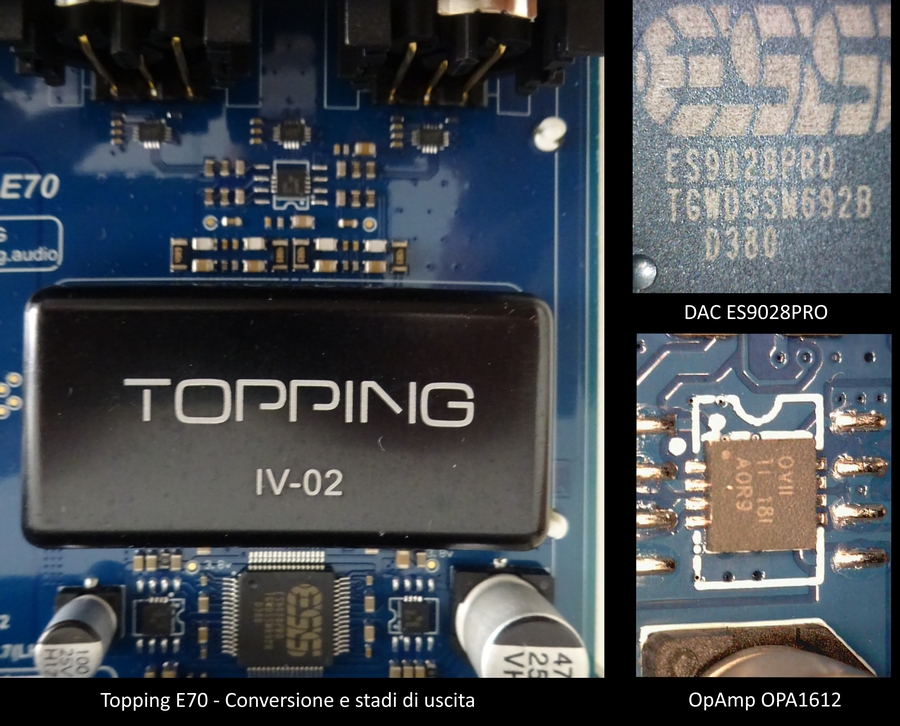
Several SMD components on the E70V and all of those on the E70 feature laser-etched markings. While this may deter counterfeiting, it makes obtaining clear photographs - even under a microscope - decidedly difficult...
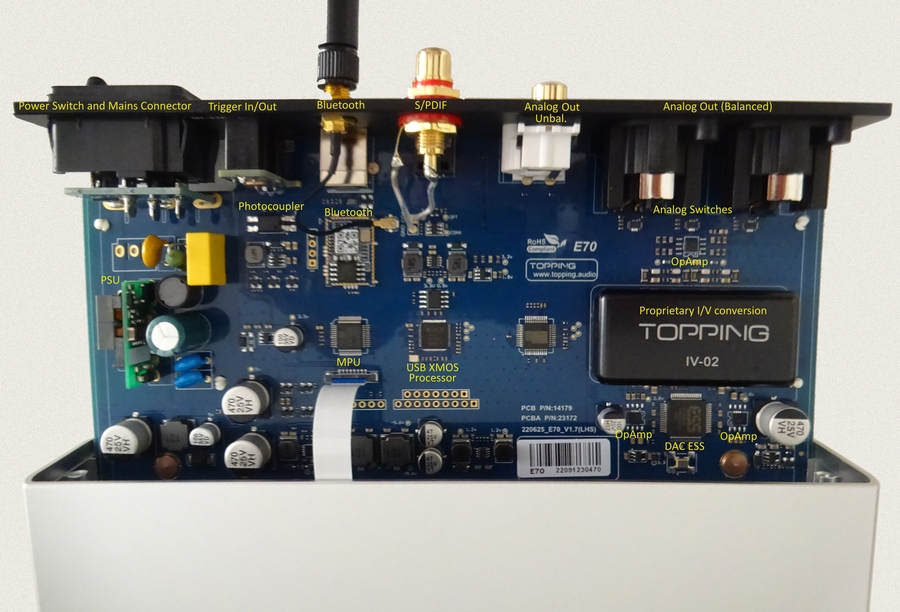
As for the E70, conversion duties are handled by the ESS ES9028PRO SABRE chip. Although widely renowned, it is somewhat dated and has been superseded within the ESS lineup by the newer ES9038PRO. Nevertheless, it boasts a rated dynamic range (DR) of 129 dB per channel across its 8 channels, alongside a Total Harmonic Distortion plus Noise (THD+N) spec of -120 dB. The channels can be deployed individually or summed in parallel: in a stereo configuration (four channels per side, as implemented here in the E70) or all eight summed in a mono configuration, which elevates the dynamic range to 135 dB. Output stages can be configured for either current-mode or voltage-mode operation.
The chip natively supports PCM decoding up to 32-bit/768kHz, DSD256 via DoP (DSD over PCM, a protocol that enables DSD stream transport over standard USB interfaces), and native DSD up to DSD1024.
However, the most notable improvement introduced in the ES9028PRO is its ability to compensate for harmonic distortion generated by downstream analogue circuitry by allowing independent calibration of second- and third-harmonic distortion components. While common practice today, this feature represented a major technological leap forward at the time of its release.
For PCM processing, the chip offers a choice of selectable FIR (Finite Impulse Response) oversampling filters: seven factory presets and one user-definable slot, allowing designers to tune the unit to achieve a specific sonic signature. These internal filters can also be bypassed entirely in favour of external oversampling engines. Downstream of the FIR filter stage during PCM playback, an IIR (Infinite Impulse Response) filter with a 47 kHz cut-off frequency (DSD F-1) is typically engaged.
When processing DSD signals, the FIR filters are bypassed entirely, routing the signal directly to the IIR stage. In this scenario, one of three alternative IIR roll-off filters (F-2, F-3, or F-4) should be selected.
The chip also supports multi-DAC parallel topologies; to ensure uniform behaviour across multiple devices, an automated gain-matching mechanism dynamically aligns output levels across all active converters.
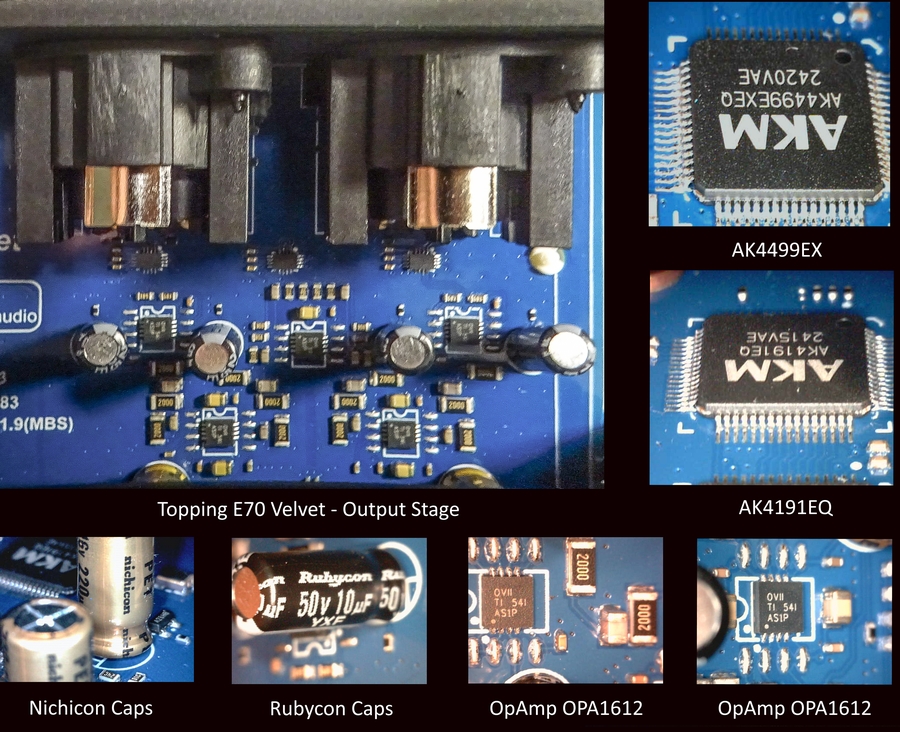
Following the converter outputs, the circuit appears to employ two dual operational amplifiers (OPA1612, marked 'OVII'), followed by a proprietary, epoxy-potted (or encapsulated) current-to-voltage (I/V) conversion module, and culminating in an additional dual op-amp of the same type.
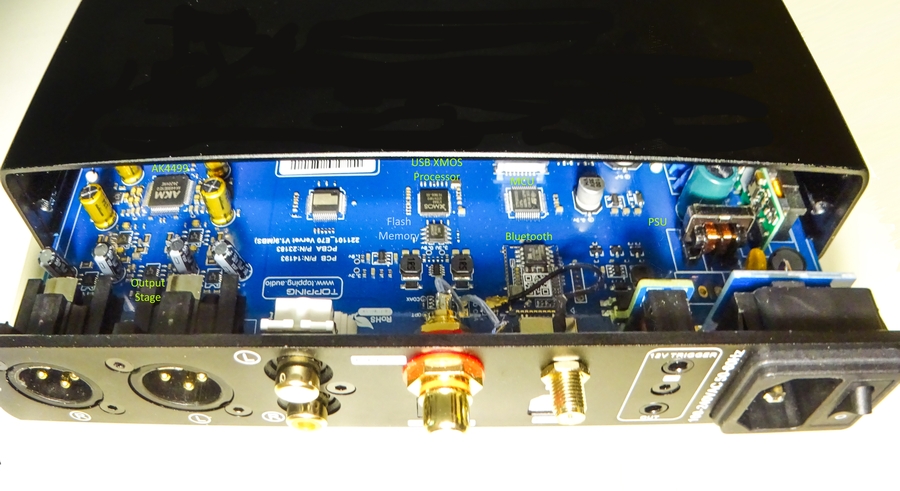
As mentioned, the E70V's DAC implementation relies on two distinct components.
The AK4491EQ is a highly advanced multi-bit converter operating in either mono or stereo mode, capable of handling PCM up to 64-bit/1536kHz and DSD up to 44.5MHz (DSD1024). The digital signal undergoes pre-processing before being fed into a delta-sigma modulator, which performs a 7-bit re-sampling at variable frequencies ranging from 5.6448 to 12.288MHz. The modulator also employs a digital low-pass filter that provides a 150dB attenuation above the Nyquist frequency. These data are then transferred in parallel mode - alternating between the left and right channels - to the AKM4499EQ.
Given that the AK4491 operates at 64 bits and is a fully digital system, the figures on its datasheet are not entirely surprising; nevertheless, seeing a THD+N of -153dB and an S/N ratio of 156dB remains quite impressive.
The AKM4499EQ receives the data stream and passes it to the switched-resistor converter, which converts it into an analogue signal. In this stage, a new patented technique called DWA (Data Weighted Average) is applied. Based on dynamic element matching, it further minimizes noise caused by the inevitable tolerances among discrete component values. At this point, the analogue signal requires only extremely gentle filtering. Here, the figures are more grounded: THD -124dB and S/N 135dB.
While a dual-chip solution undeniably increases costs, it stems from a remarkably straightforward and effective principle: physically isolating digital signal processing from analogue circuitry significantly reduces induced interference. The digital stage is inherently immune to noise but generates a substantial amount due to high frequencies and steep signal transitions; conversely, the analogue stage generates far less noise but is highly susceptible to external interference.
The output stages here are unshielded and utilize five OPA1612 operational amplifiers.
Four large golden Nichicon capacitors are deployed in the AK4499EX section, whereas several Rubycon capacitors are utilized in the subsequent analogue stage.
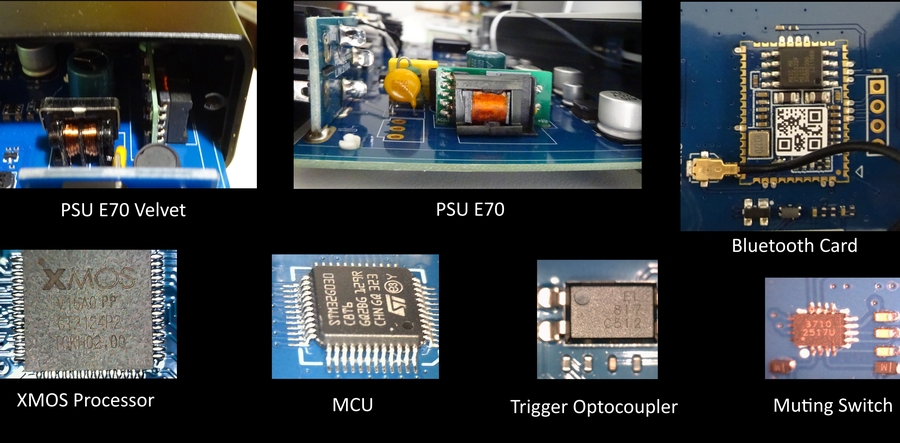
Both units feature switching power supplies, albeit with different implementations. The E70 houses numerous LDOs (low-dropout voltage regulators) marked S5YP (likely LN1130); while not particularly sophisticated, they primarily serve to isolate the various functional areas. A similar setup is found in the E70V, which additionally incorporates a low-noise regulator that I was unable to identify.
For everything else, the two systems are apparently identical.
Bluetooth connectivity is handled by Qualcomm's QCC5125, housed alongside a CMOS memory, a crystal oscillator, and other components on a daughter-board mounted onto the main board. It is an ultra-low-power System-on-a-Chip (SoC) featuring a Bluetooth 5.1 radio with support for BT Low Energy, Classic, and Dual-Mode, dual 120MHz DSPs with dedicated RAM, a 32-bit programmable CPU clocked at up to 32MHz, a USB interface, and an audio codec. An impressive piece of hardware that unfortunately demonstrates once again how the use of advanced ICs is no longer within the reach of DIYers: the chip measures just 5.5x5.5mm and features 90 pins! A curious detail: the QCC5125 is actually hidden from view, covered by a small self-adhesive label with a QR code, which on the E70 simply decodes to "E70".
The internal DAC is not used anyway (and presumably neither is the USB interface): digital-to-analogue conversion is always performed by the main DAC.
There is also a powerful XMOS XU316 multi-core processor, which handles the USB interfacing. Next to it sits a flash memory IC.
The entire system is managed by a 32-bit STM32G030 Cortex MCU.
In both units, the output stages feature SGM3710 analogue switches, presumably used for muting purposes.
There is even a touch of suspense - a mystery component: an IC with its markings carefully scraped off, situated in a fairly isolated position between the DAC and the XMOS processor.
One final detail: located behind the trigger jacks is an optocoupler, presumably to nip in the bud any risk of ground loops or even worse issues in the event of improper connections.
With all of this in place, it comes as no surprise that the claimed performance figures for the E70 models - substantially confirmed by independent measurements - are exceptionally high.
| E70 | E70 Velvet | |||
|---|---|---|---|---|
| Parameter | RCA | XLR | RCA | XLR |
| THD+N @ 1kHz (A-weighted) | < 0.00008% | < 0.00006% | < 0.00008% | < 0.00006% |
| THD 20-20kHz (unweighted, 90kHz BW) | < 0.0007% | < 0.0002% | < 0.0002% | < 0.0002% |
| SNR @ 1kHz (A-weighted) | 126dB | 132dB | 125dB | 131dB |
| Frequency response | 20-20kHz ±0.2dB
20-40kHz ±0.4dB |
20-20kHz ±0.3dB
20-40kHz ±1dB |
20-20kHz ±0.2dB
20-40kHz ±0.8dB |
|
It goes without saying that performing meaningful measurements on equipment of this calibre requires highly sophisticated instrumentation, such as Audio Precision analyzers.
In non-professional settings, however - provided one takes all necessary precautions and measures - even with these "poor relations" it is possible to achieve results that would have been unthinkable just a few years ago.
For instance, here is the spectrum obtained by analyzing the balanced output of the E70V driven by a 1kHz sine wave encoded at 24-bit / 192kHz.
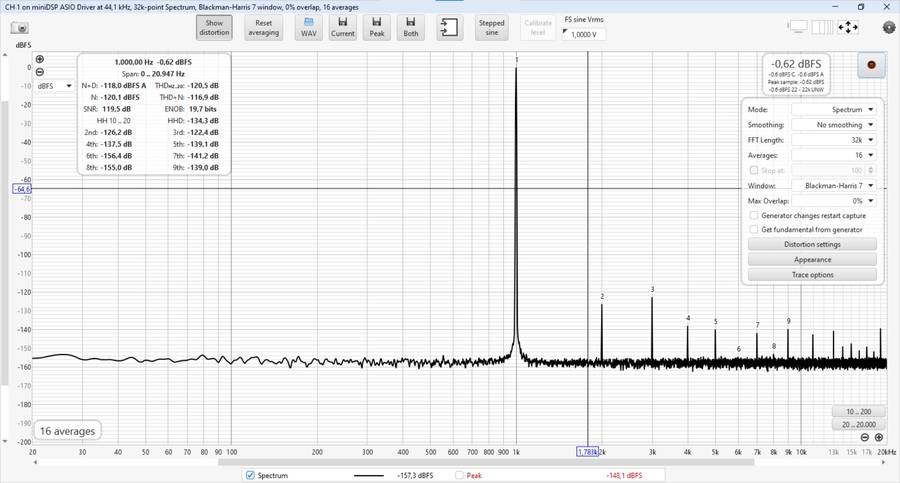
Furthermore, the measurement is bottlenecked by the parameters of the ADC used - the miniDSP Adept - which nevertheless stands second to few in terms of both absolute performance and value for money (not to mention the additional feature set it provides). I would argue that the performance level achieved is more than adequate for the needs of the average DIY audio enthusiast, while the combined cost of the pair remains orders of magnitude lower than that of an AP system.
Given the identical layout of their supporting circuitry, the interface specifications of the two models are entirely similar.
The USB input supports PCM from 44.1kHz to 768kHz and 16 to 32 bits, DSD64-DSD256 via DoP, and native DSD64-DSD512.
Compatibility is supported across Windows 10 and 11, Mac, Linux, Android, and iOS. I conducted a few tests.
For Windows, no special system requirements are specified - aside from the option to use the proprietary ASIO driver - though I strongly advise against using an overly low-spec machine. Nevertheless, I carried out part of the testing on a fairly powerful, albeit ageing, Windows 10 PC. Driver installation - the driver being identical for both models - downloaded from the Topping website, went smoothly without any issues. The driver package also installs a small ASIO control panel that displays the current sample rate and allows for adjustments to the output volume and channel balance. Once installed, the DAC appeared immediately in various software applications, which should be capable of leveraging either the ASIO driver or standard Windows audio drivers (WDM, MME, WASAPI, etc.) provided by the respective software.
In short, on my Windows 10 PC, the drivers that functioned reliably in practice were WASAPI, ASIO, and ASIO4ALL; the legacy Windows drivers appeared to run into issues. To operate at 192k/32-bit on the E70, I also had to increase the bandwidth setting to 8. Given the age of the PC, I cannot rule out that these issues were hardware-side.
On Linux, no drivers are required: the operating system automatically detects the DAC. I tested the E70 units both via Ubuntu using Rhythmbox - with no surprises - and using a Raspberry Pi 4 running Moode Audio. In the latter case, the software automatically listed the DAC among the selectable options in Moode's Audio Configuration (if it fails to do so, a simple device rescan suffices). Here, too, operation was completely trouble-free. Even after completely powering off the DAC and turning it back on, Moode immediately resumed control.
I did not conduct tests on Mac, iOS, or Android; official documentation notes that these systems operate in a plug-and-play fashion without requiring dedicated drivers.
The S/PDIF inputs (optical and coaxial) support standard PCM from 44.1 to 192kHz at 16 to 24 bits; the E70 additionally supports DSD64 via DoP.
The Bluetooth interface supports all mainstream codecs: AAC, SBC, aptX, aptX LL, aptX HD, aptX Adaptive, and LDAC.
Bluetooth functionality must be enabled as described in Part 1. Selecting the BT input puts the E70 into pairing mode, making it discoverable to client devices, which can then pair effortlessly without complex setup procedures. I tested streaming to the E70 from a Samsung TV: pairing took just a few seconds and worked flawlessly right away.
Pairing with an older Windows 10 PC was similarly straightforward; however, to achieve audio playback, I had to update a Bluetooth driver via Windows Update. Even so, measurement results indicated a very low-quality connection, likely attributable to the PC's outdated integrated Bluetooth transmitter.
With Moode, I encountered occasional glitches, which were instantly resolved by resetting the E70's Bluetooth module (achieved by holding down the brightness button on the remote control for a few seconds until "Clr" appears on the display). Under virtually identical conditions and playing the same music material, the connection to the E70 defaulted to the LDAC codec under Moode v10, whereas the E70V connected via aptX. I did not investigate this further.
As previously mentioned, the line outputs can be configured for two distinct voltage levels: 2.1V or 2.5V for RCA, and 4.2V or 5V for XLR. Both outputs can be engaged individually or simultaneously. They feature fairly low output impedance: 50 ohms for RCA and double that (100 ohms) for XLR.
Firmware updating is also supported. I performed a firmware update on the E70 using the dedicated utility and following the clear step-by-step instructions without any problems (it merely required a subsequent factory reset, which does not affect the installed firmware version), while the E70V sample I received came pre-updated to the latest firmware release.
In the next instalment we will cover listening impressions.In the meanwhile, our thanks to Audio Azimuth/Playstereo for providing the E70 review sample.
Other Topping products we reviewed: L30 II headphone amp & preamp, A50S headphone amp & preamp, PA3 integrated amp, MX3 integrated amp, DAC & headphone amp.


DISCLAIMER. TNT-Audio is neither a shop, nor a HiFi company or a repair laboratory for HiFi components. We don't sell anything. It is a 100% independent magazine that neither accepts advertising from companies nor requires readers to register or pay for subscriptions. We do not use affiliate links. If you wish, you can support our independent reviews via a PayPal donation. After publication of reviews, the authors do not retain samples other than on long-term loan for further evaluation or comparison with later-received gear. Hence, all contents are written free of any “editorial” or “advertising” influence, and all reviews in this publication, positive or negative, reflect the independent opinions of their respective authors. TNT-Audio will publish all manufacturer responses, subject to the reviewer's right to reply in turn.

© Copyright 2026 Giorgio Pozzoli - giorgio@tnt-audio.com - www.tnt-audio.com
[ Home TNT-Audio | Staff & Contacts | HiFi Playground | Listening tests | DIY & Tweakings | Music & Books ]